
Have you ever experienced a throbbing ache in your upper teeth that feels just like you need a root canal, but dental exams show nothing wrong? It could be your sinuses playing tricks on you.
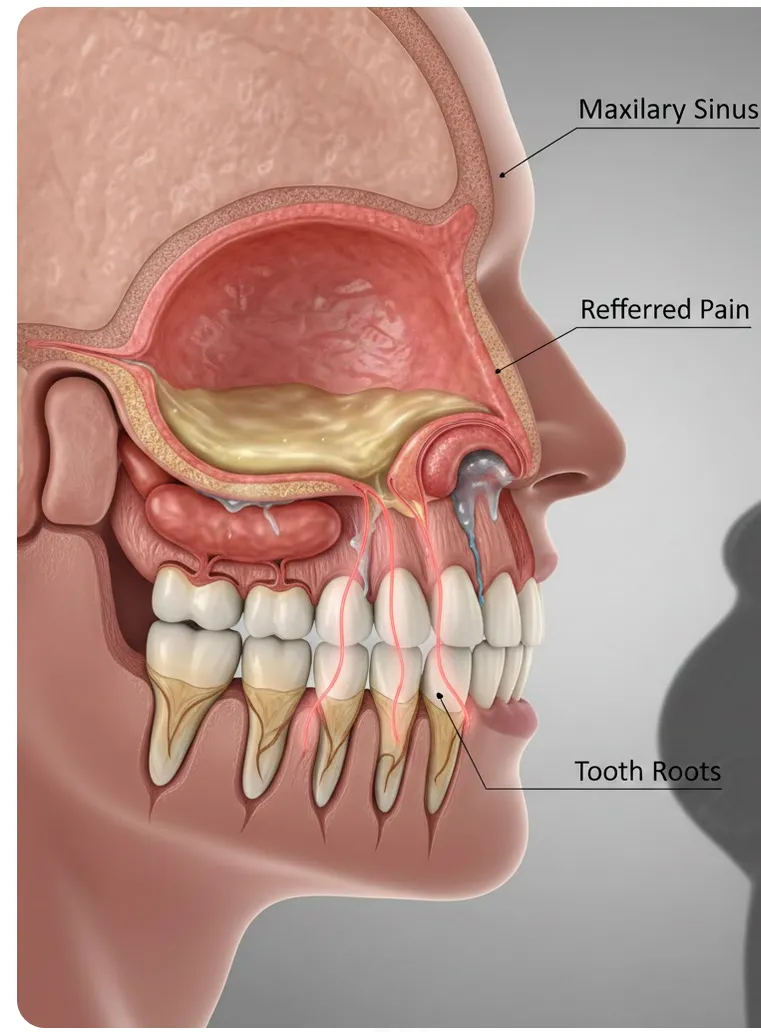
Maxillary sinusitis — inflammation of the sinuses located directly above your upper teeth — is one of the most common examples of nonodontogenic pain that mimics endodontic (root canal) pain. The proximity of the sinus floor to the roots of upper molars and premolars means that pressure or infection in the sinuses can refer pain directly to those teeth, leading to misdiagnosis and unnecessary dental procedures.
How the Sinuses Cause Tooth Pain
The maxillary sinus sits just above the roots of your upper back teeth. In many patients, the roots of the upper molars and premolars actually project into or press against the sinus floor. When the sinus membrane becomes inflamed — from a cold, allergies, or a sinus infection — that swelling and pressure can transmit directly to the tooth roots below.
This referred pain can feel identical to a genuine toothache:
- Dull, constant aching in one or more upper teeth
- Pain that worsens when bending over, lying down, or during allergy season
- Sensitivity to chewing or pressure on the affected teeth
- A feeling of fullness or pressure in the cheek area
These symptoms overlap significantly with the signs of a tooth that needs root canal treatment, which is exactly why misdiagnosis happens so frequently.
A Real-World Case: Sinus Pain Diagnosed Correctly
We recently evaluated a patient who reported discomfort after chewing in the upper right area, with no temperature sensitivity and concurrent sinus issues. The referring concern was potential root canal treatment on teeth #2, #3, or #4.
Our examination told a different story: no mobility, normal response to percussion and palpation, no significant clinical findings. CBCT 3D imaging confirmed healthy teeth with roots in close anatomical proximity to the maxillary sinus floor.
Diagnosis: Normal Pulp, Normal Apical Tissues. No endodontic treatment needed.
“I’ve never had a consultation like this. It is so detailed and now I understand.”
This case saved the patient from an unnecessary and costly root canal procedure. See the full case with CBCT images →
Research Supports the Sinus-Tooth Pain Connection
This isn’t an isolated occurrence. Published research demonstrates just how common sinus-related tooth pain is:
- Sinus abnormalities were found in approximately 32.5% of cases in a study of patients referred for TMJ imaging, where sinus issues confounded diagnoses by mimicking orofacial pain
- A notable case report describes a pregnant woman who developed sinusitis secondary to pregnancy rhinitis, presenting as severe tooth pain that appeared endodontic in origin. Pulp vitality tests were normal, radiographs showed no dental issues, and treatment with decongestants and antibiotics resolved the “dental” pain without any root canal work
- Reviews consistently emphasize that unilateral sinus pain overlaps with toothache symptoms, especially when accompanied by nasal congestion, post-nasal drip, or headaches
Warning Signs That Your “Toothache” May Be Sinus-Related
Several clues can help distinguish sinus-referred pain from a true dental problem:
Symptoms Pointing Toward Sinuses
- Pain affects multiple upper teeth rather than a single tooth
- Pain worsens when bending over, lying down, or with changes in head position
- Concurrent nasal congestion, post-nasal drip, or headaches
- Symptoms coincide with a cold, flu, or allergy season
- Pain is a dull pressure or aching rather than sharp or throbbing
Dental Tests That Rule Out Tooth Problems
- Teeth respond normally to cold and vitality testing
- No decay, cracks, or infection visible on examination or X-rays
- CBCT imaging shows healthy roots with no periapical pathology
- Pain does not respond to dental anesthesia as expected
If your tooth pain comes with any of these sinus-related patterns, consult an ENT specialist alongside your dentist — it might save you from an unneeded procedure.
Why a Detailed Consultation Matters More Than a Free One
You may see “free consultation” offers on sponsored Google ads when searching for a root canal dentist in Torrance. While that sounds appealing, consider what a free consultation typically includes — and what it leaves out.
A consultation without comprehensive diagnostics — CBCT 3D imaging, pulp vitality testing, percussion testing, and thorough clinical examination — can easily miss non-dental causes of pain like sinusitis. When sinus pressure is misattributed to a tooth, the result is an unnecessary root canal on a perfectly healthy tooth. That “free” consultation just cost you thousands of dollars in unneeded treatment.
At our office, 30% of consultations reveal that the pain source is non-dental, saving patients from unnecessary procedures. Our comprehensive consultation includes advanced CBCT 3D imaging, vitality testing, and a detailed treatment plan discussion — everything needed to get the diagnosis right the first time.
A detailed consultation is an investment that prevents costly mistakes. Use our cost estimator to get a personalized estimate for your visit.
The Endodontist’s Role in Accurate Diagnosis
As endodontists in Torrance, we specialize in diagnosing the true source of tooth and jaw pain. Our diagnostic approach for potential sinus-related pain includes:
- CBCT 3D imaging to visualize the relationship between tooth roots and the sinus floor
- Pulp vitality testing to confirm whether teeth are healthy
- Percussion and palpation testing to evaluate each tooth individually
- Differential diagnosis training to distinguish dental pain from sinus pressure, shingles, muscle pain, bruxism, and nerve conditions
When a patient presents with upper tooth pain but no clear dental cause, our job is recognizing when the problem isn’t a tooth at all — and directing the patient to appropriate care before any unnecessary dental work is done.
Key Takeaways
- Maxillary sinusitis is a common cause of upper tooth pain that mimics root canal symptoms
- The roots of upper molars and premolars sit close to the sinus floor, making referred pain from sinus inflammation feel identical to a toothache
- CBCT imaging and pulp vitality testing are essential for differentiating sinus pain from true dental problems
- A thorough consultation can save you from unnecessary root canal treatment and thousands of dollars
- If upper tooth pain coincides with sinus symptoms, consult an ENT specialist alongside your dentist
Experiencing Upper Tooth Pain?
If you’re dealing with persistent upper tooth pain and aren’t sure whether it’s dental or sinus-related, a specialist evaluation can provide definitive answers. At Phan Endodontic Partners in Torrance, we use CBCT 3D imaging and advanced diagnostic protocols to get to the root of your pain — whether it’s dental or not.
Call (310) 378-8342 to schedule a consultation.