
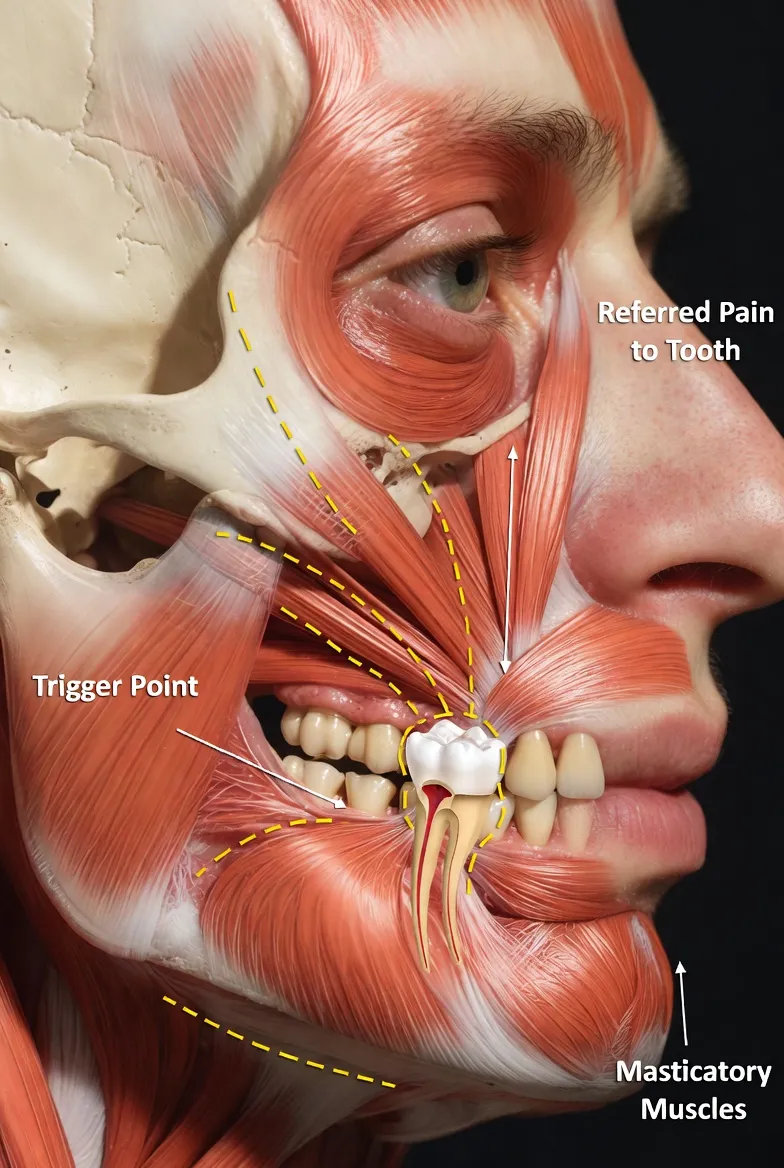
A patient once arrived here referred for a root canal: two weeks of ear ache and lower-tooth pain. Every dental test came back healthy. Then I pressed on his masseter — the main chewing muscle — and his exact pain appeared on command. Total treatment: massage. That case now sits in our files as the root canal we didn't do.
How a muscle throws its voice.
Overworked jaw muscles develop trigger points — taut, irritable knots that refer pain elsewhere, the way a heart attack refers pain down the arm. The key muscles involved are the masseter (your primary chewing muscle along the jaw) and the temporalis (the broad muscle on the side of your head). When these muscles become overworked from stress, clenching, poor posture, or overuse, they develop trigger points that send referred pain to nearby teeth.
Masseter trigger points famously refer into the upper and lower back teeth and the ear. The teeth feel like the problem; they’re only the projection screen. This referred pain can feel deep in the tooth roots, making it virtually indistinguishable from a genuine dental problem.
- A dull, deep ache — not the sharp throb of infection, but deep pain that feels like it's inside the tooth
- Ear pain or fullness alongside the toothache
- Worse with stress, chewing gum, or long dental visits — also poor posture and prolonged computer work
- Pain that moves or involves several teeth rather than one clearly identifiable tooth
- Pressing the cheek muscle reproduces it — the giveaway
- Clicking, popping, or locking of the jaw joint
Published case reports document patients who underwent unnecessary dental evaluations — and in some cases, unnecessary dental procedures — before the muscle origin of their pain was identified. The diagnosis was ultimately made through careful palpation of the facial muscles. Treatment with massage and muscle relaxants resolved the symptoms entirely — no dental work required. Broader reviews of orofacial pain literature underscore that masticatory myofascial pain syndrome shares symptoms with true dental issues, but lacks the hallmark signs of pulp inflammation: normal responses to vitality testing, no periapical pathology on imaging, and no decay or cracks.
The five-minute test worth a thousand dollars.
After the dental tests come back healthy — CBCT 3D imaging shows no periapical pathology, cracks, or decay, and pulp vitality testing confirms teeth are healthy and responsive — we palpate the chewing muscles systematically. Reproducing your exact pain from a muscle while every tooth tests normal is diagnostic.
Treatment is unglamorous and effective: targeted massage and trigger point therapy to release tight muscle bands, stretching, stress management, sometimes a night guard if clenching contributes, posture correction for desk workers, and Botox injections for severe cases. The tooth stays whole. These treatments are less invasive and less expensive than root canal treatment — but only if the correct diagnosis is made first.
Toothache plus ear ache plus healthy dental tests — press the jaw muscles before anyone drills. Referred muscle pain fools patients and clinicians alike.
Muscle pain resolves with muscle treatment. No root canal has ever cured a trigger point.