
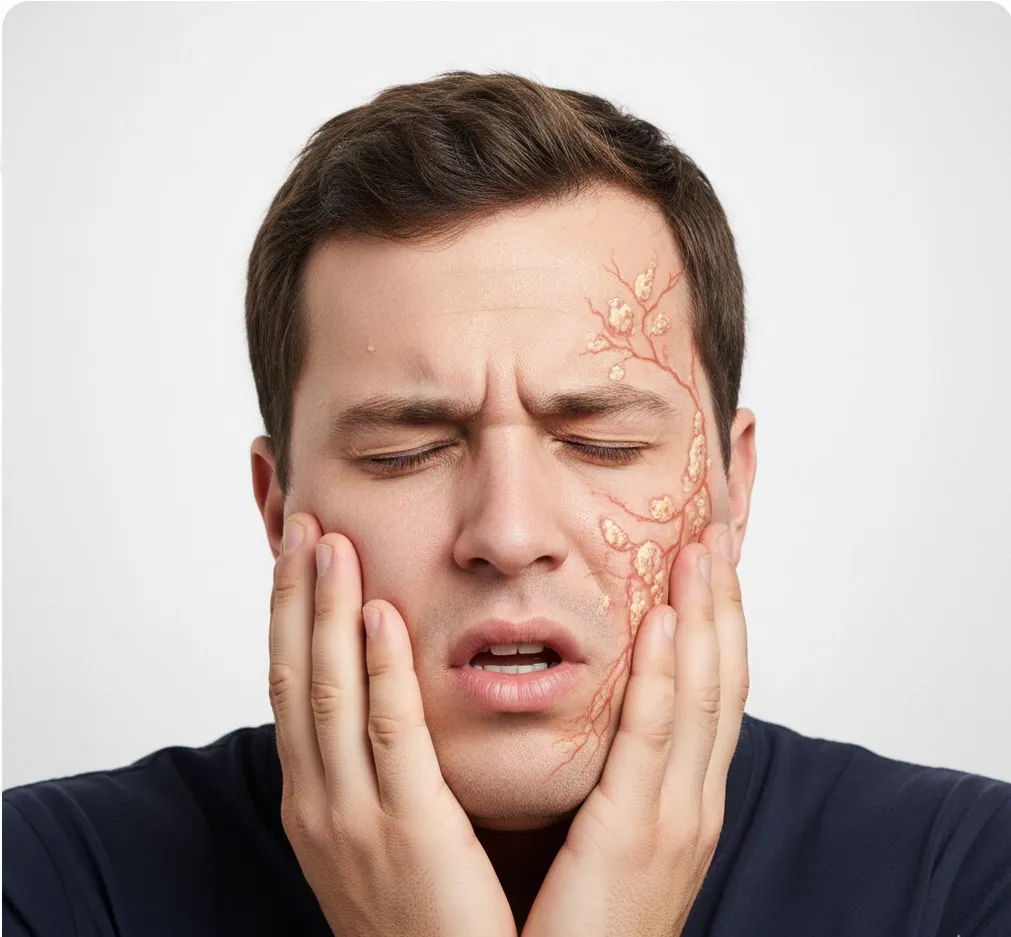
Of all the conditions that impersonate a toothache, shingles is the cruelest trickster — because it can produce genuine, severe tooth pain days before the telltale rash appears. In that window, healthy teeth get root canals and extractions that were never needed.
How a childhood virus becomes a toothache.
The chickenpox virus (varicella-zoster) never leaves; it lies dormant in nerve cells for decades. When it reawakens as shingles along the trigeminal nerve — the main nerve serving your face and teeth — the earliest symptom can be burning, aching pain in the teeth and jaw of one side, with absolutely nothing wrong with the teeth themselves. One in three people who had chickenpox will develop shingles in their lifetime, with risk increasing significantly after age 50.
The trigeminal nerve has three branches: the ophthalmic (V1, serving forehead and scalp), the maxillary (V2, serving upper teeth, upper jaw, and cheek), and the mandibular (V3, serving lower teeth, lower jaw, chin, and tongue). When shingles reactivates along V2 or V3, it produces symptoms virtually indistinguishable from dental problems — deep aching tooth pain, sharp shooting pain along the jaw, burning or tingling in the gums, and sensitivity to touch on the face or inside the mouth.
- Strictly one-sided — the pain never crosses the midline of the face
- Burning or tingling quality, unlike the throb of an infected tooth
- Skin sensitivity — the cheek or scalp may hurt to light touch
- Normal dental tests — vitality, percussion, and imaging all clean
- The rash arrives later — clustered blisters, typically 2–5 days after the pain begins
- Pain affects multiple teeth or a broad area following a dermatomal pattern
- Pain doesn't respond to local anesthesia in the expected way
The prodromal trap: pain before the rash.
What makes dental shingles particularly dangerous is the timeline. During the prodromal phase (1–5 days), there is no rash — only pain. A patient arrives with severe tooth pain, and clinical examination and X-rays show nothing wrong. This diagnostic gap can lead to unnecessary root canal treatment on a healthy tooth, tooth extraction that doesn’t resolve the pain, multiple dental visits without finding the cause, and delayed antiviral treatment. After the prodromal phase, the active phase brings the diagnostic blistering rash along the nerve pathway, followed by the healing phase where blisters crust over within 2–4 weeks.
Why the timing matters medically.
Antiviral medication (such as valacyclovir or acyclovir) works best when started within 72 hours of the rash — and prompt treatment reduces the risk of postherpetic neuralgia (PHN), the lingering nerve pain that can follow shingles and last months or even years. A dentist who recognizes the pattern early doesn’t just save a tooth from unnecessary treatment; they get you to a physician inside the treatment window. Risk factors for developing PHN include older age (especially over 60), severe initial rash, severe pain during the acute phase, and delayed antiviral treatment.
"When every dental test comes back healthy, the answer isn't a stronger drill — it's a wider differential."
What to do if you suspect dental shingles.
Don’t rush into irreversible dental treatment. If X-rays and clinical exams show healthy teeth, consider waiting briefly before proceeding with extraction or root canal. A short observation period can reveal whether a rash develops. See your physician or urgent care — a doctor can prescribe antiviral medication, and these medications are most effective when started within 72 hours of symptom onset. Get an endodontic evaluation — we use CBCT 3D imaging and advanced pulp vitality testing to definitively confirm or rule out dental causes. Monitor for blisters or a rash on the skin of the face, inside the mouth, or on the scalp — especially on the same side as the pain.
Risk factors that should raise suspicion: age over 50, recent illness or stress, weakened immune system, and history of chickenpox (though nearly all adults over 40 have had it).
Prevention: the Shingrix vaccine.
The most effective prevention is the Shingrix vaccine, recommended for adults 50 and older and adults 19 and older with weakened immune systems. Shingrix is over 90% effective at preventing shingles and significantly reduces the risk of postherpetic neuralgia. It’s given as two doses, 2–6 months apart. Even if you’ve had shingles before, vaccination can help prevent future episodes.
Other impostors worth ruling out.
Shingles is just one of several non-dental conditions that masquerade as a toothache. Other causes worth exploring: sinus pressure — maxillary sinusitis can refer pain to upper teeth; myofascial pain — trigger points in jaw muscles send referred pain to teeth; bruxism — chronic grinding causes tooth soreness that imitates endodontic problems; and trigeminal neuralgia — a nerve disorder causing intense, electric-shock-like facial pain. A detailed consultation with CBCT imaging is the best way to determine the true source of your pain.
One-sided facial and tooth pain with clean dental tests — especially with skin sensitivity — deserves a shingles question before any irreversible dental work.
If a rash appears near recent tooth pain, see a physician promptly: antivirals are time-sensitive. Your teeth will wait; the virus won't.