
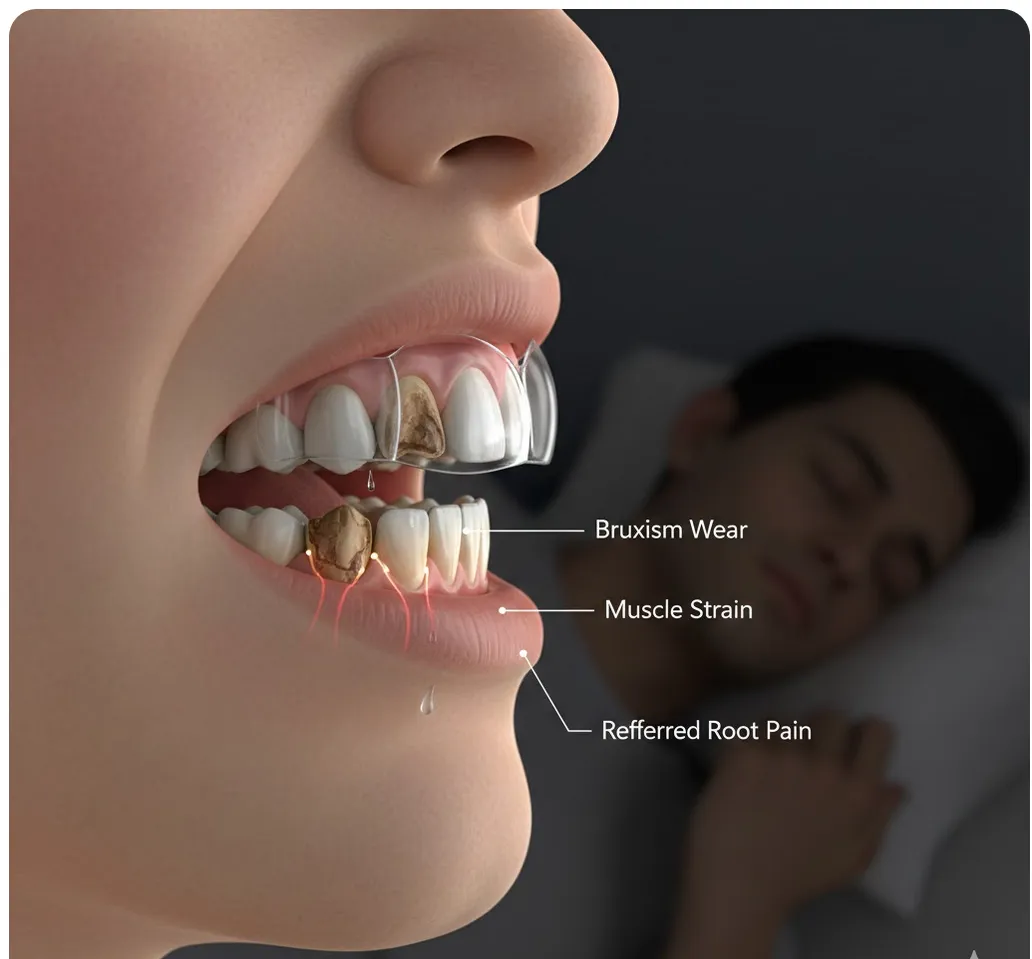
Every week, someone arrives certain a tooth is dying — aching, temperature-sensitive, tender to bite. And every week, for some of them, the culprit isn't infection at all. It's what their jaw does for hours every night while they sleep.
How grinding impersonates an infection.
Clenching and grinding load teeth with forces far beyond chewing — hundreds of pounds, hours at a time. The ligament around a battered tooth becomes inflamed and bite-tender; the overworked nerve turns temperature-sensitive. From the inside, it feels exactly like the early stages of a dying tooth. From our chair, the difference shows in the details.
The constant pressure from grinding places enormous stress on your teeth, jaw muscles, and temporomandibular joint. Over time, this leads to muscle fatigue in the masseter and temporalis muscles (causing referred pain to teeth), microtrauma to tooth structures, inflammation of the periodontal ligament, and secondary TMJ problems that radiate pain to the teeth and face. The resulting pain can feel identical to genuine endodontic disease — but in many bruxism cases, the pulp inside the tooth is perfectly healthy. The pain is coming from the structures around the tooth, not from within it.
- Morning-dominant pain — worst on waking, easing through the day
- Several teeth, or moving targets — infections pick one tooth and stay
- Jaw muscle fatigue — cheeks tired, temples tight, headaches in the temple area
- Flattened, worn tooth surfaces — the fingerprints of grinding
- Healthy vitality tests — normal cold response, clean imaging, no periapical pathology
- Brief temperature sensitivity — seconds, not lingering like a dying nerve
Without comprehensive testing, bruxism-related pain can be misattributed to endodontic disease. Patients may undergo fillings, crowns, or even root canals on teeth that are structurally and pulpally healthy, only to find the pain persists because the underlying grinding habit was never addressed.
The test that settles it.
Vitality testing, percussion, imaging — tooth by tooth. A grinding-stressed tooth responds normally to cold and shows clean bone on the scan; an infected one doesn’t. CBCT 3D imaging and pulp vitality testing are essential for confirming that teeth are healthy before recommending any treatment.
When the tests say healthy, the treatment isn’t a root canal — it’s a night guard, bite adjustment where warranted, stress management, and sometimes physical therapy or Botox for severe cases. The pain fades over weeks as the ligament recovers. These interventions are far less invasive and less costly than root canal treatment — but only if the correct diagnosis is made first.
"A root canal cannot cure a habit. It just gives the habit a quieter tooth to bruise."
Bite pain plus healthy vitality tests points to bruxism, not infection — and the fix is protection, not a root canal.
If a treated tooth keeps aching, or several teeth take turns hurting, ask about grinding before anyone treats another one.