
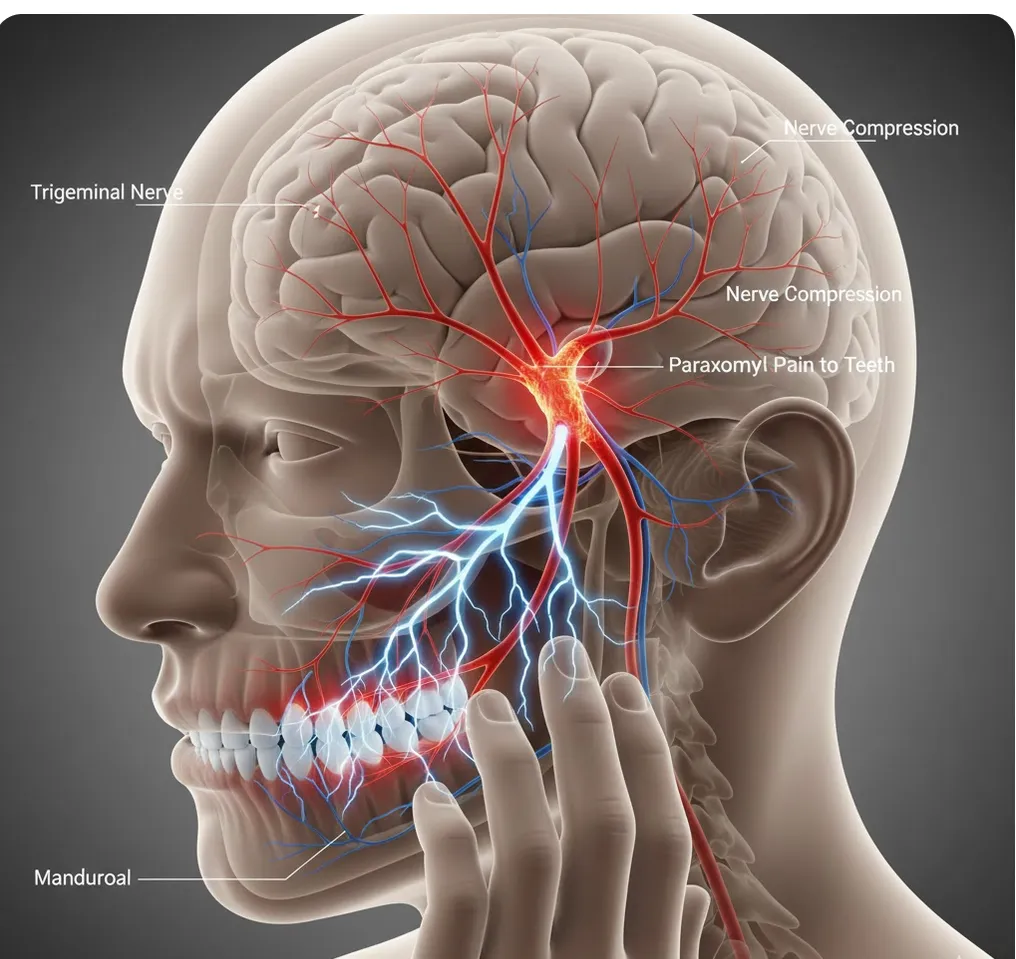
This is the impostor with the saddest case histories: patients who arrive having already lost two, three, four healthy teeth to a pain that no extraction could touch — because the problem was never in a tooth. It was in the nerve that serves them all.
Pain from the wiring, not the fixture.
Trigeminal neuralgia is a disorder of the fifth cranial nerve — the trunk line for facial and dental sensation. The trigeminal nerve has three branches: ophthalmic (V1, forehead and scalp), maxillary (V2, upper teeth, upper jaw, cheek), and mandibular (V3, lower teeth, lower jaw, chin, tongue). When the V2 or V3 branches misfire, the nerve produces electric-shock pain that patients locate, with total conviction, in a tooth. But the tooth is only the address the nerve reports; the fault is upstream. The severity of the pain has earned it the name “the suicide disease.”
- Electric, stabbing jolts lasting seconds to two minutes — not the sustained throb of infection
- Triggered by light touch — a breeze, shaving, brushing teeth, washing face, even talking
- Shock-free intervals between attacks — infected teeth ache continuously
- Strictly one-sided, often in recurring "volleys" following a nerve distribution pattern
- Every dental test normal — vitality, percussion, imaging all clean
- Pain does not respond to local anesthesia in the typical way
The dental literature documents multiple cases where patients underwent unnecessary root canal treatment before trigeminal neuralgia was recognized. In two well-documented case reports, patients had root canals performed on healthy teeth before the correct diagnosis was made. Once identified, carbamazepine therapy (an anticonvulsant medication) resolved the pain completely — no dental treatment was ever needed. In another case series, space-occupying lesions such as tumors caused painful trigeminal neuropathy that presented as toothache, leading to dental treatments attributed to the wrong cause until MRI revealed intracranial pathology.
Why the stakes are so high.
Dental treatment doesn’t just fail against neuralgia — it can worsen it, and every extracted tooth costs real anatomy while the pain marches on. The pattern to fear is serial treatment: a root canal that didn’t help, then an extraction that didn’t help, then the neighboring tooth under suspicion. That sequence is a flashing sign to stop and reconsider the diagnosis.
Reviews of mimicking lesions show that up to 43% are malignancies or metastases. This means that facial pain mimicking a toothache can sometimes be the first sign of a serious condition — a tumor pressing on or invading the trigeminal nerve. When dental evaluation finds no cause for the pain, the next step must be neurological evaluation with appropriate imaging (MRI), not another dental procedure.
Other neurological conditions that can mimic dental pain include shingles (herpes zoster reactivating along the trigeminal nerve), postherpetic neuralgia (chronic nerve pain persisting months or years after a shingles outbreak), atypical odontalgia (persistent dentoalveolar pain with no identifiable dental cause), and referred pain from intracranial pathology such as tumors or aneurysms. Progressive worsening over weeks or months, numbness or tingling accompanying the pain, or associated neurological symptoms like vision changes are additional warning signs pointing away from a dental origin.
"When treatment after treatment fails to touch the pain, the diagnosis — not the dentistry — is what needs revisiting."
When testing points to neuralgia, the right referral is a neurologist: medication manages most cases well, and other options exist beyond it. The dentist’s job — our job — is recognizing the pattern and protecting your teeth from a misdirected search.
Electric-shock pain in seconds-long jolts, triggered by light touch, with clean dental tests — that's a nerve condition, and it needs a neurologist, not a root canal.
If you've already lost a tooth to pain that didn't change afterward, stop the sequence. Get the diagnosis re-examined before any more dentistry.