
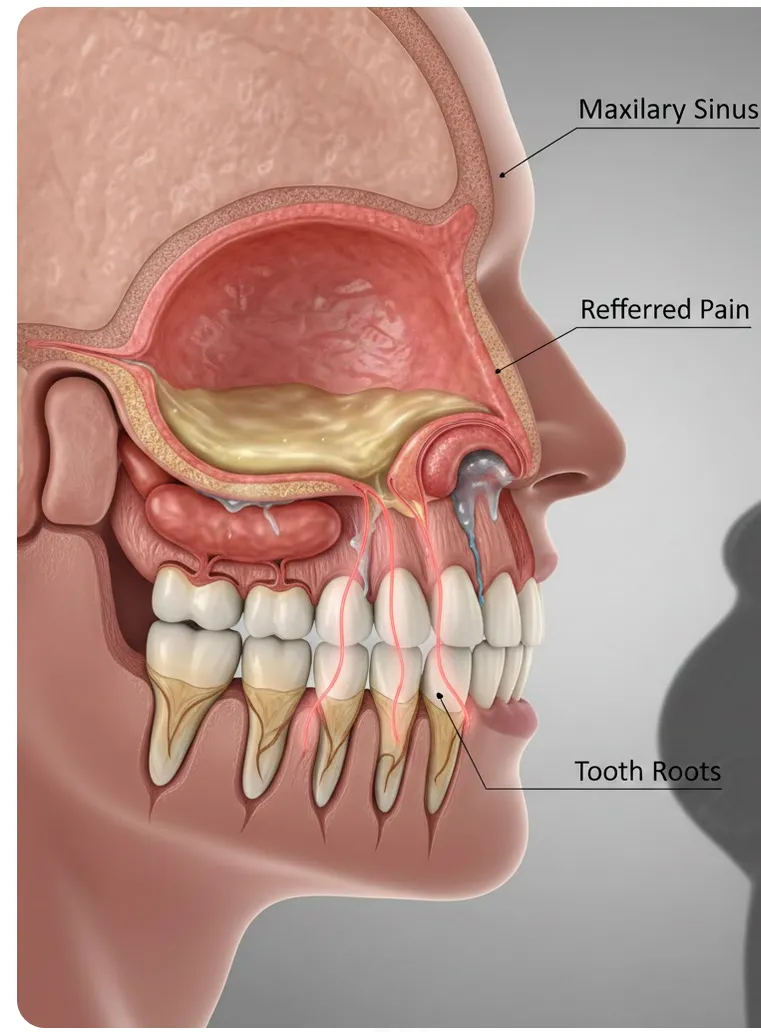
The roots of your upper back teeth and the floor of your maxillary sinus are next-door neighbors — sometimes separated by less than a millimeter, sometimes not separated at all. When the sinus becomes inflamed, it presses directly on those roots. The result: a completely convincing toothache in completely healthy teeth.
The most common impostor of them all.
The maxillary sinus sits just above the roots of your upper back teeth. In many patients, the roots of the upper molars and premolars actually project into or press against the sinus floor. When the sinus membrane becomes inflamed — from a cold, allergies, or a sinus infection — that swelling and pressure transmits directly to the tooth roots below.
- Several upper back teeth ache at once — infections pick one
- Worse when bending over or lying down — pressure shifting in the sinus
- Tender when you tap your cheekbone, not just a tooth
- Congestion, post-nasal drip, or a recent cold travelling with the pain
- Chewing hurts on the whole side, not one reproducible spot
- A dull pressure or aching rather than sharp or throbbing
Sinus abnormalities were found in approximately 32.5% of cases in a study of patients referred for TMJ imaging, where sinus issues confounded diagnoses by mimicking orofacial pain. Reviews consistently emphasize that unilateral sinus pain overlaps with toothache symptoms, especially when accompanied by nasal congestion, post-nasal drip, or headaches.
One scan, both suspects.
This differential used to be guesswork; CBCT ended that. One 3D scan reads the tooth roots and the sinus floor together — showing whether the source is a dental infection pushing up into the sinus, sinus inflammation pressing down on healthy roots, or (not rarely) both at once, each needing different care. Pulp vitality testing, percussion, and palpation testing evaluate each tooth individually. Pain that does not respond to dental anesthesia as expected is another key indicator. Our case files include exactly this puzzle, solved in one visit.
"The question isn't tooth or sinus. It's tooth, sinus, or both — and only the scan answers it."
When it’s the sinus, treatment belongs to your physician — decongestants, sometimes antibiotics — and the “toothache” dissolves as the sinus clears. When it’s the tooth, root canal treatment resolves the sinus irritation it was causing. Treating the wrong one helps nobody.
And if the toothache outlives the sinus infection by more than a week or two, come back: occasionally the cold merely unmasked a real dental problem.
Multiple upper teeth aching, worse on bending over, with congestion — think sinus before root canal. One CBCT scan settles it definitively.
And if the toothache outlives the sinus infection by more than a week or two, come back: occasionally the cold merely unmasked a real dental problem.