
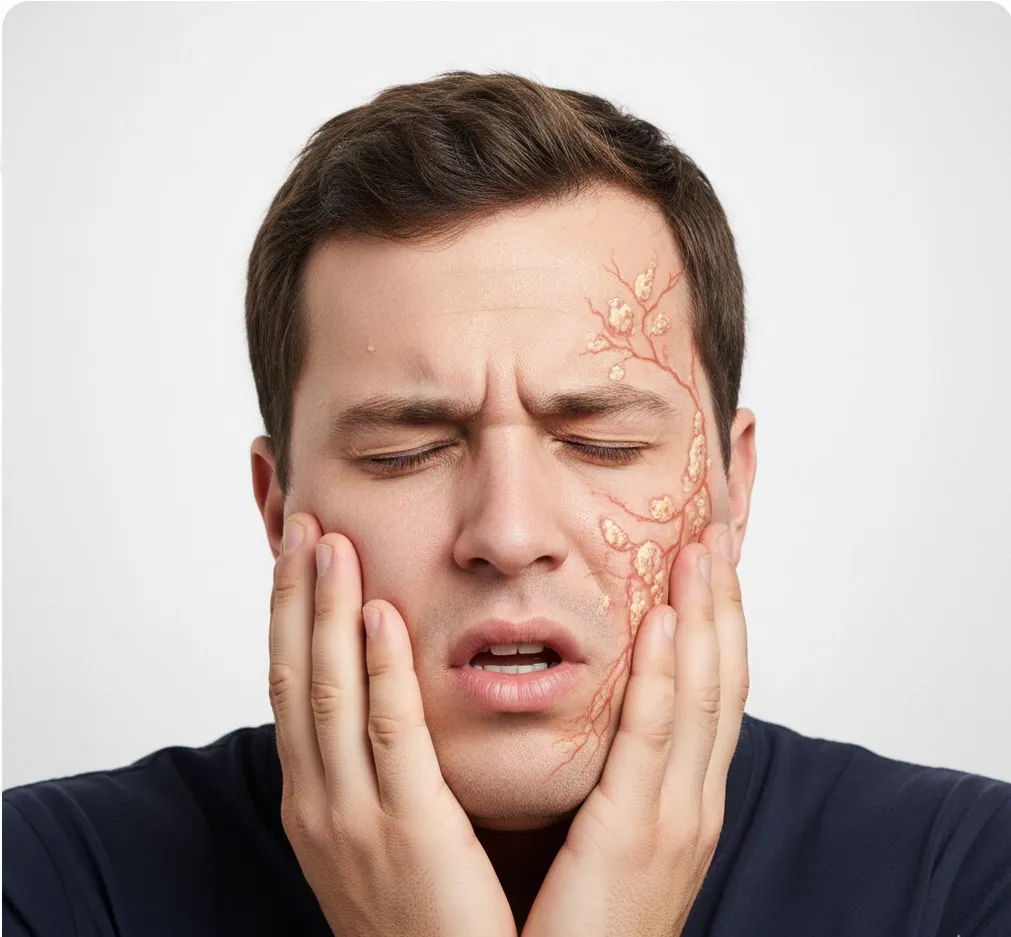
As an endodontist, I regularly see patients referred for tooth pain that turns out to have nothing to do with their teeth. One of the most commonly missed diagnoses is shingles (herpes zoster) affecting the trigeminal nerve—the main nerve that provides sensation to your face, teeth, and jaws.
When shingles strikes the trigeminal nerve, the pain can feel identical to a toothache. Without recognizing the signs, patients may undergo unnecessary dental procedures—extractions, root canals, or other treatments—on perfectly healthy teeth.
Here’s what you need to know about this frequently misdiagnosed condition.
What Is Shingles?
Shingles is caused by the varicella-zoster virus (VZV), the same virus that causes chickenpox. After you recover from chickenpox, the virus doesn’t leave your body. It lies dormant in nerve cells and can reactivate decades later as shingles.
Key facts about shingles:
- 1 in 3 people who had chickenpox will develop shingles in their lifetime
- Risk increases significantly after age 50
- Stress, illness, and immune-suppressing conditions can trigger reactivation
- The virus travels along a nerve pathway, causing pain and eventually a rash in the area that nerve supplies
How Shingles Mimics Tooth Pain
The trigeminal nerve has three branches that supply sensation to different parts of your face:
- Ophthalmic branch (V1): Forehead, upper eyelid, scalp
- Maxillary branch (V2): Upper teeth, upper jaw, cheek, lower eyelid, side of the nose
- Mandibular branch (V3): Lower teeth, lower jaw, chin, tongue, lower lip
When shingles reactivates along the maxillary (V2) or mandibular (V3) branches, it can produce symptoms that are virtually indistinguishable from dental problems:
- Deep, aching tooth pain in one or more teeth
- Sharp, shooting pain along the jaw
- Sensitivity to touch on the face or inside the mouth
- Burning or tingling sensations in the gums or teeth
- Pain that doesn’t respond to dental treatment
This is why shingles in the trigeminal nerve is sometimes called “dental shingles”—the pain can be so convincing that both patients and clinicians initially suspect a tooth problem.
The Diagnostic Challenge: Pain Before the Rash
What makes dental shingles particularly tricky is the timeline. During the prodromal phase (1–5 days), there is no rash—only pain. A patient arrives with severe tooth pain, and clinical examination and X-rays may show nothing wrong with the teeth.
Shingles follows a predictable pattern:
Prodromal Phase (1–5 days)
Pain, tingling, or burning develops before any visible signs. This is when misdiagnosis is most likely.
Active Phase
A blistering rash appears along the nerve pathway, confirming the diagnosis.
Healing Phase
Blisters crust over and heal within 2–4 weeks.
This diagnostic gap can lead to:
- Unnecessary root canal treatment on a healthy tooth
- Tooth extraction that doesn’t resolve the pain
- Multiple dental visits without finding the cause
- Delayed antiviral treatment (which is most effective when started early)
Signs That Tooth Pain May Be Shingles
While a definitive diagnosis requires medical evaluation, several clues can help distinguish shingles from true dental problems:
Pain Characteristics
- Pain affects multiple teeth or a broad area rather than one specific tooth
- Pain follows a dermatomal pattern — it stays on one side of the face and doesn’t cross the midline
- The pain has a burning, electric, or tingling quality rather than the typical throbbing of a toothache
- Pain doesn’t respond to local anesthesia in the expected way
Clinical Findings
- No dental cause found on examination or X-rays (no decay, cracks, or infection)
- Teeth test normally to vitality tests (cold test, electric pulp test)
- Skin sensitivity in the area — even light touch on the face or scalp may be painful
- Rash or blisters appear on the skin or inside the mouth (often a few days after pain starts)
Risk factors
- Age over 50
- Recent illness or stress
- Weakened immune system (from medication, chemotherapy, or chronic conditions)
- History of chickenpox (though nearly all adults over 40 have had it)
What to Do If You Suspect Dental Shingles
1. Don’t rush into irreversible dental treatment
If X-rays and clinical exams show healthy teeth, consider waiting briefly before proceeding with extraction or root canal treatment. A short observation period can reveal whether a rash develops.
2. See your physician or urgent care
A doctor can evaluate for shingles and prescribe antiviral medication (such as valacyclovir or acyclovir). These medications are most effective when started within 72 hours of symptom onset—so timely diagnosis matters.
3. Get an endodontic evaluation
An endodontist has specialized training and diagnostic tools to determine whether a tooth is truly the source of pain. At our office, we use CBCT 3D imaging and advanced pulp vitality testing to definitively confirm or rule out dental causes. In fact, 30% of our consultations reveal that the pain source is non-dental, saving patients from unnecessary treatment.
4. Monitor for a rash
Keep watch for blisters or a rash appearing on the skin of the face, inside the mouth, or on the scalp—especially on the same side as the pain. This typically appears 1–5 days after pain begins and confirms the diagnosis.
Postherpetic Neuralgia: When the Pain Doesn’t Stop
One of the most challenging complications of shingles is postherpetic neuralgia (PHN) — chronic nerve pain that persists long after the rash has healed. PHN can last months or even years and may feel like ongoing tooth or jaw pain. This is another reason early diagnosis and treatment are critical — starting antiviral medication promptly can reduce both the severity and duration of shingles and lower the risk of developing chronic pain afterward.
Risk factors for developing PHN include:
- Older age (especially over 60)
- Severe initial rash
- Severe pain during the acute phase
- Delayed antiviral treatment
Prevention: The Shingles Vaccine
The most effective prevention against shingles is the Shingrix vaccine, recommended by the CDC for adults 50 years and older and adults 19 years and older with weakened immune systems.
Shingrix is over 90% effective at preventing shingles and significantly reduces the risk of postherpetic neuralgia. It’s given as two doses, 2–6 months apart. Even if you’ve had shingles before, vaccination can help prevent future episodes.
Talk to your physician about whether the Shingrix vaccine is right for you.
The Endodontist’s Role in Diagnosis
As endodontists, we’re specialists in diagnosing the source of tooth and jaw pain. Our advanced diagnostic approach includes:
- CBCT 3D imaging to visualize tooth roots and surrounding bone in detail
- Pulp vitality testing to determine whether a tooth’s nerve is healthy
- Selective anesthesia to isolate which tooth (if any) is causing pain
- Differential diagnosis training to distinguish dental pain from non-dental causes like shingles, trigeminal neuralgia, referred pain from sinuses, myofascial pain, and bruxism
When a patient presents with tooth pain but no clear dental cause, part of our job is recognizing when the problem isn’t a tooth at all—and directing the patient to appropriate medical care before any unnecessary dental work is done.
Other Conditions That Mimic Root Canal Pain
Shingles is just one of several non-dental conditions that can masquerade as a toothache. If you’re experiencing unexplained tooth pain, these other causes are worth exploring:
- Sinus pressure — maxillary sinusitis can refer pain to upper teeth, perfectly mimicking root canal symptoms
- Myofascial pain — trigger points in jaw muscles can send referred pain to teeth
- Bruxism — chronic grinding and clenching causes tooth soreness that imitates endodontic problems
- Trigeminal neuralgia — a nerve disorder causing intense, electric-shock-like facial pain
A detailed consultation with CBCT imaging is the best way to determine the true source of your pain and avoid unnecessary treatment.
Key Takeaways
- Shingles can cause severe tooth and jaw pain that mimics dental problems
- Pain typically appears before the rash, making early diagnosis difficult
- If dental exams and X-rays show healthy teeth, consider non-dental causes
- Early antiviral treatment (within 72 hours) improves outcomes significantly
- The Shingrix vaccine is highly effective at preventing shingles
- An endodontic evaluation can help confirm or rule out dental causes of facial pain
Experiencing Unexplained Tooth Pain?
If you’re dealing with persistent tooth pain and your dentist hasn’t found a clear cause, a specialist evaluation can provide answers. At Phan Endodontic Partners in Torrance, we use advanced CBCT 3D imaging and comprehensive diagnostic protocols to get to the root of your pain—whether it’s dental or not.
Call (310) 378-8342 to schedule a consultation. Learn what our comprehensive evaluation includes →