
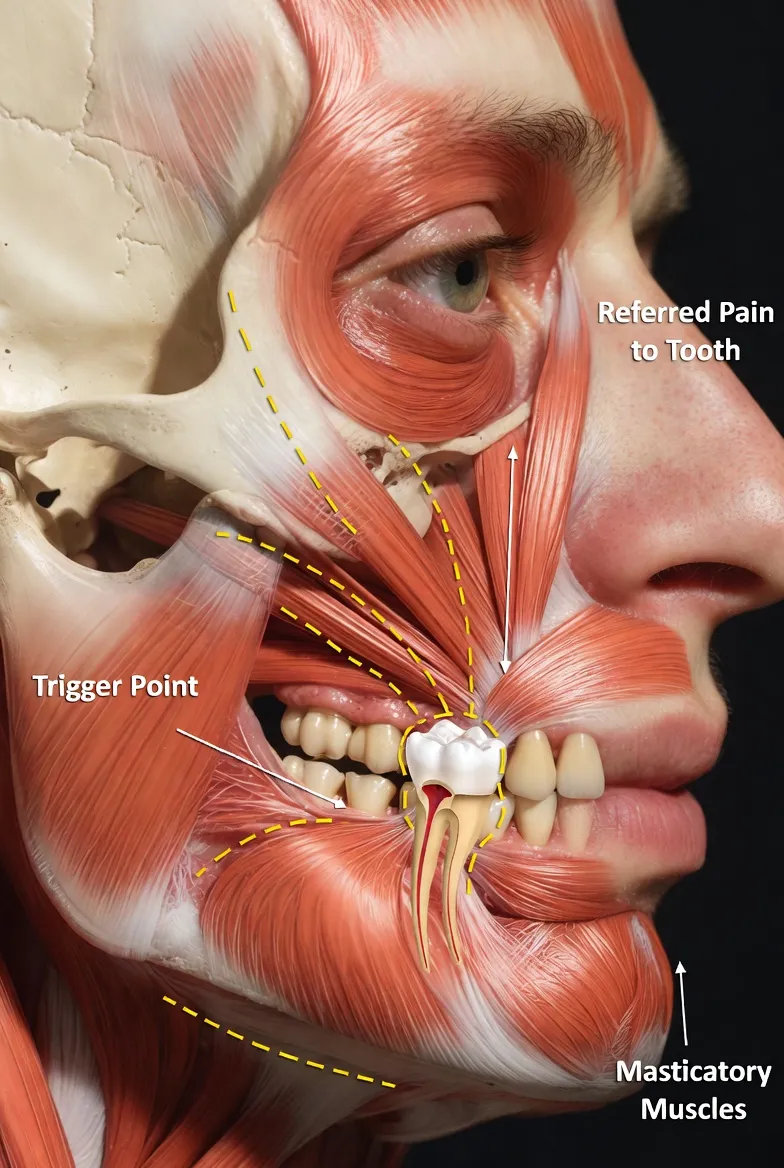
Muscle soreness in the jaw and face can be a sneaky impostor, referring pain directly to your teeth and making you think a root canal is imminent. If you’ve been told you need a root canal but something doesn’t feel right about the diagnosis, the culprit might not be your tooth at all — it could be your muscles.
What Is Myofascial Pain?
Myofascial pain syndrome occurs when trigger points — hyperirritable spots in tight bands of muscle — develop in the masticatory muscles. The key muscles involved are the masseter (your primary chewing muscle along the jaw) and the temporalis (the broad muscle on the side of your head).
When these muscles become overworked from stress, clenching, poor posture, or overuse, they can develop trigger points that send referred pain to nearby teeth. This referred pain can feel deep in the tooth roots, making it virtually indistinguishable from a genuine dental problem.
How Muscle Pain Mimics a Root Canal Problem
Myofascial trigger points in the jaw muscles can produce symptoms that closely mirror endodontic issues:
- Deep, aching tooth pain that feels like it’s coming from inside the tooth
- Sensitivity to temperature and pressure on specific teeth
- Dull throbbing that comes and goes, often worsening with stress
- Pain that radiates to the ear, temple, eyebrow, or TMJ area
- Soreness in multiple teeth rather than a single, clearly identifiable tooth
The overlap with genuine dental problems is significant. A patient may describe symptoms that check every box for root canal treatment, yet the teeth themselves are completely healthy. Without a comprehensive exam that includes muscle evaluation, the true source of pain can be missed entirely.
Case Evidence: Trigger Points Mimicking Endodontic Pain
Published case reports document patients who underwent unnecessary dental evaluations — and in some cases, unnecessary dental procedures — before the muscle origin of their pain was identified. In one well-documented case, referred pain from a myofascial trigger point in the masseter muscle perfectly imitated endodontic pain, complete with sensitivity to temperature and pressure.
The diagnosis was ultimately made through careful palpation of the facial muscles and trigger point therapy. Treatment with massage and muscle relaxants resolved the symptoms entirely — no dental work required.
Broader reviews of orofacial pain literature underscore that masticatory myofascial pain syndrome shares symptoms like dull aching and sharp pain with true dental issues, but lacks the hallmark signs of pulp inflammation — normal responses to vitality testing, no periapical pathology on imaging, and no decay or cracks.
Warning Signs That Your Tooth Pain May Be Muscular
If you’re experiencing tooth pain, these clues may suggest a myofascial origin rather than a dental one:
Symptoms Pointing Toward Muscle Pain
- Jaw fatigue or soreness, especially in the morning or after extended chewing
- Clicking, popping, or locking of the jaw joint
- Tenderness when pressing on the masseter or temporalis muscles
- Pain that worsens with stress, poor sleep, or prolonged computer work
- Headaches that accompany the tooth pain
- Pain affects multiple teeth or shifts location
Dental Tests That Rule Out Tooth Problems
- Teeth respond normally to cold and electric pulp testing
- CBCT 3D imaging shows no periapical pathology, cracks, or decay
- No dental cause identified on clinical examination
- Pain doesn’t resolve with dental treatment (a red flag for non-dental origin)
If your tooth pain comes with jaw fatigue, clicking, or tenderness when pressing on facial muscles, it might be myofascial — not dental.
Treatment for Myofascial Pain
When muscle pain is correctly identified as the source, treatment is entirely different from root canal therapy:
- Physical therapy targeting the masticatory muscles
- Massage and trigger point therapy to release tight muscle bands
- Relaxation techniques and stress management
- Botox injections for severe cases of muscle tension
- Oral appliances (night guards) if clenching contributes to the problem
- Posture correction for patients who spend long hours at a desk
These treatments are less invasive and less expensive than root canal treatment — but only if the correct diagnosis is made first.
Why a Detailed Consultation Matters More Than a Free One
You may see “free consultation” offers on sponsored Google ads when searching for root canal treatment in Torrance. While the price tag is appealing, consider what that consultation actually includes.
A consultation that skips comprehensive diagnostics — CBCT 3D imaging, pulp vitality testing, and muscle palpation — can easily attribute muscle-referred pain to a tooth. The result? A root canal on a perfectly healthy tooth that doesn’t resolve the pain, because the muscles were the problem all along.
At our office, 30% of consultations reveal that the pain source is non-dental, saving patients from unnecessary procedures. Our comprehensive evaluation includes not only advanced imaging and vitality testing but also assessment of the muscles, jaw joint, and other potential non-dental sources of pain.
A detailed consultation costs less than a single unnecessary procedure. Use our cost estimator to understand what your visit includes.
The Endodontist’s Role in Ruling Out Dental Causes
As endodontists in Torrance, our expertise lies in determining whether a tooth is truly the source of pain. For patients with potential myofascial pain, our diagnostic approach includes:
- CBCT 3D imaging to definitively rule out cracks, decay, infection, and periapical pathology
- Pulp vitality testing to confirm teeth are healthy and responsive
- Muscle and TMJ assessment to check for trigger points and jaw joint dysfunction
- Differential diagnosis to distinguish dental pain from sinus pressure, bruxism, shingles, and neurological conditions
When we determine that a tooth is not the source of pain, we direct patients to the appropriate specialist — whether that’s a TMD specialist, physical therapist, or pain management provider. Getting the right diagnosis first prevents costly mistakes.
Key Takeaways
- Myofascial trigger points in the jaw muscles can refer pain to teeth, closely mimicking root canal symptoms
- Stress, clenching, poor posture, and overuse are common causes of myofascial pain
- Pulp vitality testing and CBCT imaging are essential for confirming that teeth are healthy before any treatment
- Treatment for myofascial pain — physical therapy, massage, relaxation — is less invasive and less costly than unnecessary dental procedures
- A comprehensive exam that includes muscle evaluation is critical for accurate diagnosis
Jaw Pain That Won’t Go Away?
If you’re dealing with persistent tooth or jaw pain and previous dental evaluations haven’t found a clear cause, a specialist consultation can provide answers. At Phan Endodontic Partners in Torrance, we use advanced CBCT 3D imaging and thorough diagnostic protocols to determine whether your pain is dental or muscular in origin.
Call (310) 378-8342 to schedule a consultation.