
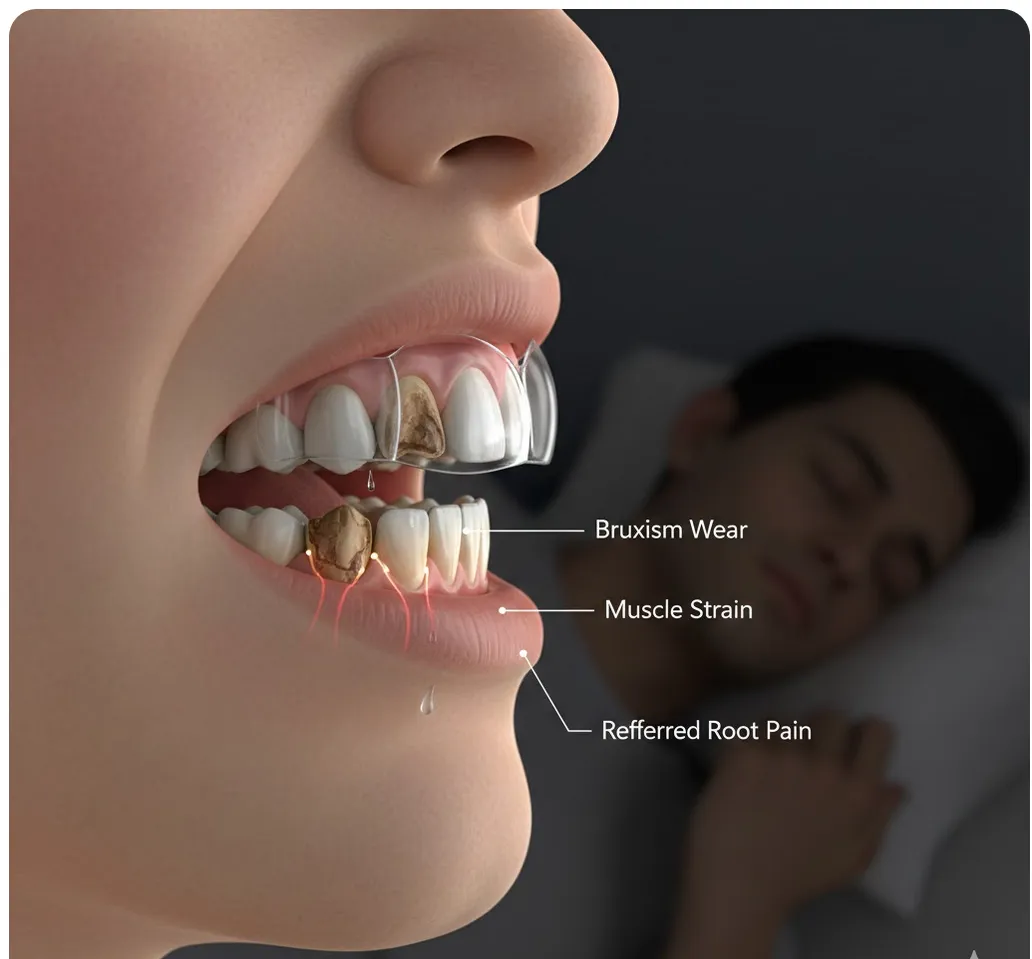
Bruxism — chronic teeth grinding and clenching, often during sleep — is a surprisingly common cause of jaw and tooth pain that can closely resemble the need for a root canal. If you’re waking up with sore teeth or a dull ache in your molars, the problem may not be inside the tooth at all.
How Bruxism Creates Tooth Pain
The constant pressure from grinding and clenching places enormous stress on your teeth, jaw muscles, and temporomandibular joint (TMJ). Over time, this leads to:
- Muscle fatigue in the masseter and temporalis muscles, causing referred pain to teeth
- Microtrauma to tooth structures — tiny cracks and stress fractures in enamel and dentin
- Inflammation of the periodontal ligament (the tissue anchoring teeth to bone), creating sensitivity to biting
- Secondary TMJ problems that radiate pain to the teeth and face
The resulting pain can feel identical to genuine endodontic disease — a dull throbbing deep in the tooth that makes you think the nerve is dying. But in many bruxism cases, the pulp (nerve) inside the tooth is perfectly healthy. The pain is coming from the structures around the tooth, not from within it.
Symptoms of Bruxism That Mimic Root Canal Pain
Bruxism-induced pain shares many features with genuine dental problems:
- Dull, constant aching in one or more teeth, especially molars
- Pain that is worse in the morning after nighttime grinding
- Sensitivity to biting and chewing on the affected side
- Tooth soreness that seems to shift between teeth
- Jaw stiffness and fatigue upon waking
- Headaches, particularly in the temple area
What makes bruxism particularly tricky is that the pain often focuses on specific teeth — the ones bearing the most grinding force — which makes it easy to mistake for a single-tooth problem requiring root canal treatment.
The Risk of Misdiagnosis
Without comprehensive testing, bruxism-related pain can be misattributed to endodontic disease. In studies of TMD and orofacial pain, bruxism frequently contributes to tooth pain that is mistaken for dental pathology. Patients may undergo dental procedures — fillings, crowns, or even root canals — on teeth that are structurally and pulpally healthy, only to find the pain persists because the underlying grinding habit was never addressed.
This is particularly common when:
- A patient reports pain in a tooth with existing dental work (fillings or crowns), making it easy to assume the restoration is the problem
- X-rays show no obvious pathology, but the provider proceeds with treatment based on symptoms alone
- The patient isn’t asked about grinding habits, jaw clenching, or morning soreness
Warning Signs That Your Pain May Be From Bruxism
Clues Pointing Toward Bruxism
- Morning jaw soreness or stiffness that improves throughout the day
- Flattened, worn-down, or chipped teeth — visible evidence of grinding
- A bed partner reports hearing you grind your teeth at night
- Jaw fatigue after prolonged chewing or stressful days
- Headaches concentrated in the temples
- Pain in multiple teeth rather than a single clearly identifiable tooth
- Tooth sensitivity to cold that is brief (seconds, not lingering)
Dental Tests That Confirm Healthy Teeth
- Teeth respond normally to pulp vitality testing (cold test, electric pulp test)
- CBCT 3D imaging shows no periapical pathology, fractures, or infection
- Percussion testing may show generalized sensitivity (not localized to one tooth)
- No decay or cracks extending into the pulp
If your teeth test healthy but the pain persists, bruxism should be high on the list of suspects.
Treatment for Bruxism
When bruxism is correctly identified as the cause of tooth pain, treatment focuses on protecting the teeth and reducing muscle strain — not on root canals:
- Custom night guards (occlusal splints) — the primary treatment to prevent grinding damage during sleep
- Stress management — since stress is a major trigger for bruxism
- Biofeedback therapy — to increase awareness of clenching habits during the day
- Physical therapy — to address jaw muscle tension and TMJ strain
- Botox injections — for severe bruxism that doesn’t respond to other treatments
- Sleep evaluation — since bruxism is sometimes linked to sleep disorders like sleep apnea
These interventions are far less invasive and less costly than root canal treatment — but only if the correct diagnosis is made before proceeding with dental procedures.
Why a Detailed Consultation Matters More Than a Free One
When searching for a root canal specialist in Torrance, you may encounter “free consultation” offers on sponsored Google ads. The appeal is understandable — but what does a free consultation actually involve?
A consultation that lacks comprehensive diagnostics — CBCT 3D imaging, pulp vitality testing, and thorough clinical examination including assessment of wear patterns and muscle tension — can easily misattribute bruxism pain to an endodontic problem. The result is a root canal on a healthy tooth that doesn’t resolve the pain, followed by more procedures chasing a problem that was never dental.
At our office, 30% of consultations reveal that the pain source is non-dental, saving patients from unnecessary treatment. Our comprehensive consultation includes advanced 3D imaging, vitality testing, and evaluation of habits like grinding and clenching that are often overlooked elsewhere.
Paying for a thorough evaluation upfront is far less expensive than paying for procedures you never needed. Get a personalized cost estimate for your visit.
The Endodontist’s Role in Bruxism-Related Pain
As endodontists in Torrance, our primary role is determining whether pain is truly coming from inside a tooth. For patients with potential bruxism-related symptoms, our evaluation includes:
- CBCT 3D imaging to rule out fractures, infection, and periapical disease
- Pulp vitality testing to verify that the tooth nerve is healthy
- Wear pattern assessment to identify signs of chronic grinding
- Muscle and TMJ evaluation to check for associated jaw problems
- Differential diagnosis to distinguish bruxism from sinus pain, myofascial pain, shingles, and neurological conditions
When we confirm that teeth are healthy, we guide patients toward appropriate bruxism treatment and coordinate with their general dentist for night guard fabrication.
Key Takeaways
- Bruxism (teeth grinding and clenching) is a common cause of tooth pain that mimics root canal symptoms
- The pain arises from muscle fatigue, microtrauma, and ligament inflammation — not from the tooth pulp
- Morning jaw soreness, worn teeth, and pain in multiple teeth are hallmark signs of bruxism
- Pulp vitality testing and CBCT imaging are essential for confirming that teeth are healthy before recommending any treatment
- Treatment with night guards and stress management is far less invasive than unnecessary root canal procedures
Waking Up With Tooth Pain?
If you’re experiencing morning tooth or jaw pain that hasn’t been explained by previous dental visits, a specialist evaluation can determine whether bruxism — not your teeth — is the cause. At Phan Endodontic Partners in Torrance, we use CBCT 3D imaging and comprehensive testing to separate dental problems from grinding-related pain.
Call (310) 378-8342 to schedule a consultation.