Your Root Canal Didn’t Work. Now What?
So you had a root canal — maybe a few months ago, maybe years ago — and now the pain is back. Or the swelling came back. Or your dentist is looking at your X-ray with that face that says something’s not right.
First, take a breath. A failed root canal doesn’t mean your tooth is done. It doesn’t mean you did anything wrong either. Root canals have a great success rate, somewhere around 90-95%. But that means roughly 5-10% of them don’t hold up over time. And when they don’t, that’s where retreatment comes in.
Dr. Jason Phan sees retreatment cases every single week here in Torrance. Patients come from Redondo Beach, Manhattan Beach, Gardena, Carson, and all over the South Bay. Most of them walk in nervous and walk out saying, “That was way easier than I expected.”
Let’s talk about what retreatment actually is, why your first root canal might have failed, and what Dr. Phan does differently the second time around.
Retreatment Success Rate
Microscope Magnification
Missed Canals Found with CBCT
What Is Root Canal Retreatment, Exactly?
Think of it like this. Your first root canal cleaned out the infection, shaped the canals, and sealed everything up. Retreatment means we’re opening that tooth back up, taking out the old filling material, and starting over — but with better technology, better visualization, and a specialist who does this all day.
Here’s the basic idea:
- We remove the crown or filling to get back into the tooth
- We take out all the old gutta-percha (that’s the rubber-like filling from the first root canal)
- We re-clean and re-shape every canal — including any that were missed the first time
- We disinfect everything thoroughly using our GentleWave system and Fotona laser
- We re-seal the canals with fresh material and close things back up
The whole thing usually takes about 90 minutes. One visit in most cases.
Why Root Canals Fail
Here’s Dr. Phan’s honest take — most root canals that fail weren’t done poorly on purpose. The original dentist did their best with the tools they had. But root canal anatomy is incredibly complex, and without a microscope or 3D imaging, some things just get missed.
Here are the most common reasons he sees:
Missed Canals
This is the number one reason. A lot of upper molars have four canals, but many dentists only find three. Some lower molars have a hidden canal called the MB2 that’s easy to miss without magnification. Without a microscope, you literally can’t see it. Studies show that missed canals account for up to 40% of retreatment cases.
Incomplete Cleaning
If bacteria got left behind — even a tiny amount — they can multiply over months or years and cause a new infection. Traditional cleaning methods only reach the main canal. The tiny side branches and curves? Those are where stubborn bacteria hide.
Delayed or Missing Crown
This one breaks Dr. Phan’s heart because it’s so preventable. You get the root canal done, you feel better, and then you put off getting the crown. Meanwhile, the temporary filling starts to break down. Bacteria sneak back in. Months later, you’ve got a re-infection. If your dentist says get a crown within 2-4 weeks — do it.
New Decay
Even after a perfect root canal, new cavities can form around the tooth. If decay reaches the sealed area, bacteria can reinfect the canals from the outside.
Cracks
Hairline cracks that weren’t visible during the first treatment can develop over time. They create a pathway for bacteria to get in, and they’re almost impossible to see without a microscope or CBCT 3D scan.
Signs Your Root Canal May Have Failed
- Pain that came back weeks or months later
- Swelling near the treated tooth
- A pimple or bump on the gum that won't go away
- Sensitivity to hot or cold that returned
- Tooth feels different when you bite down
- Dark area showing up on your X-ray
A Patient Story: The Missed Canal
A patient came to us from Hermosa Beach a while back. She’d had a root canal on her lower molar about two years earlier at her general dentist’s office. Everything seemed fine for about 18 months, and then the throbbing started again. Dull at first, then impossible to ignore.
Her dentist took an X-ray and said, “It looks like the root canal failed. You might need an extraction.”
She didn’t want to lose the tooth. She found Dr. Phan online and came in for a consult.
Dr. Phan took a CBCT 3D scan — and there it was. A fourth canal that was never treated the first time. You couldn’t see it on a regular X-ray. The untreated canal had been harboring bacteria for two years, slowly building up an infection at the root tip.
We retreated the tooth, cleaned all four canals (including the missed one), and sealed it up. She got her crown a few weeks later. That was over a year ago and she’s had zero problems since.
This is the kind of thing Dr. Phan sees all the time. It’s not that the first dentist made a mistake — they just didn’t have the tools to find what was hiding.
How Dr. Phan Evaluates Your Tooth
Before we do anything, we need to figure out WHY the first root canal failed. That changes the treatment plan completely.
CBCT 3D Imaging
This is the game-changer. A regular dental X-ray is flat — it’s like looking at a shadow. Our CBCT scanner takes a 3D image of your tooth from every angle. Dr. Phan can rotate it, slice through it, and see things that are invisible on traditional films.
With CBCT, he can:
- Spot missed canals that the first provider never found
- Identify cracks that are causing the problem
- See exactly where the infection is sitting
- Measure how close the roots are to nerves and sinuses
- Decide if retreatment will work or if you need a different approach
Microscope Examination
Once we start the procedure, the surgical microscope gives Dr. Phan 25x magnification. That’s like looking at your tooth through binoculars. He can see the old filling material, identify every canal opening, and spot fracture lines that are invisible to the naked eye.
Most general dentists don’t have this kind of microscope. It’s one of the biggest reasons retreatment success rates are higher with an endodontist.
The Retreatment Process, Step by Step
Consultation & 3D Scan
We take a CBCT scan and Dr. Phan reviews it with you right then and there. He'll show you on the screen exactly what went wrong and whether retreatment is the right call. No guessing.
Numbing & Isolation
You'll be completely numb before we start. We also offer sedation options if you're anxious. A rubber dam goes on to keep the tooth clean and dry.
Remove Old Materials
Dr. Phan removes the existing crown or filling, then carefully takes out all the old gutta-percha and sealer from inside the canals. This is the tedious part — it takes patience and precision under the microscope.
Find & Clean All Canals
Now comes the detective work. Using the microscope and the CBCT as a map, Dr. Phan locates every canal — including the ones that were missed. Each canal gets cleaned, shaped, and disinfected using the GentleWave system and Fotona laser.
Re-Seal & Restore
Fresh biocompatible filling material seals every canal. A temporary filling goes on top, and you'll head back to your regular dentist for a new crown within 2-4 weeks.
Another Patient Story: The Crown That Waited Too Long
A guy from Torrance came in — mid-40s, no dental issues for years. He’d had a root canal on an upper premolar about 3 years prior. His dentist told him to come back for a crown. Life got busy. He never went back.
The temporary filling eventually wore down. He didn’t feel any pain so he figured everything was fine. Then one morning he woke up with his face swollen on one side.
When Dr. Phan looked at the scan, bacteria had re-entered the canals through the broken-down temporary filling and created an abscess at the root tip. The good news? The tooth itself was structurally sound. We retreated it, he got his crown this time (we made sure), and the tooth has been great since.
The lesson is pretty simple: when your dentist says get a crown after your root canal, get the crown.
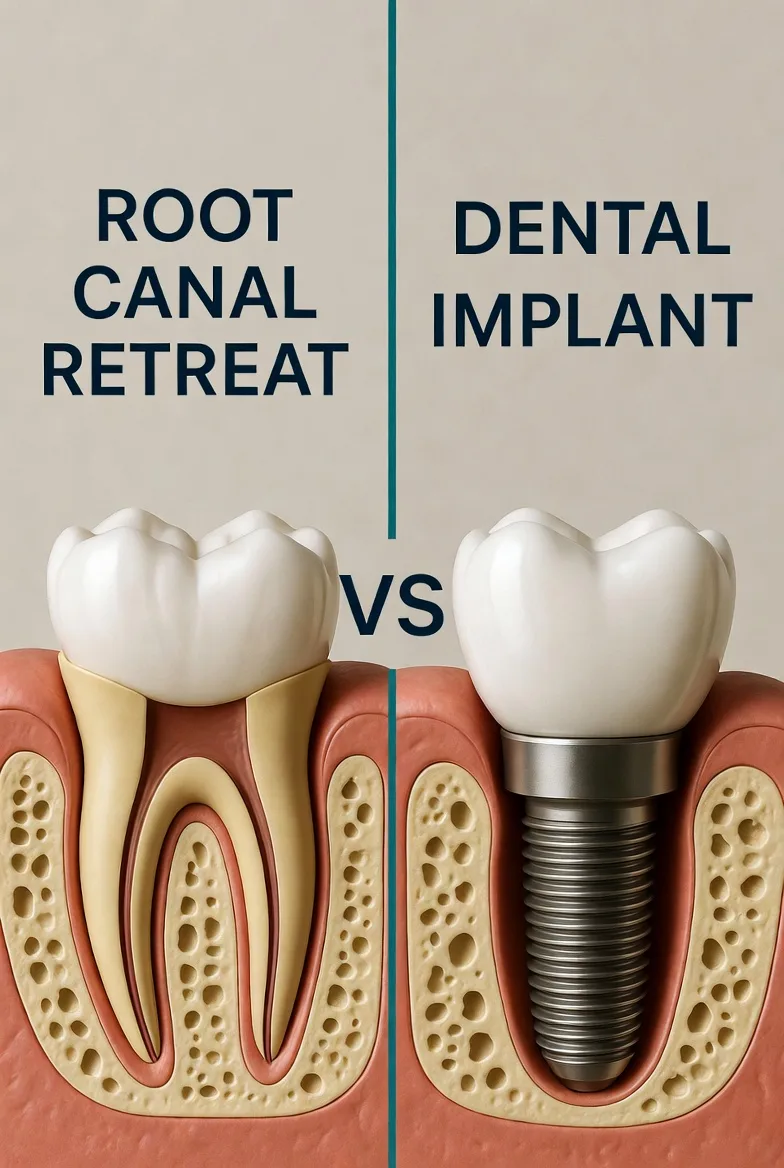
Retreatment vs. Apicoectomy vs. Extraction
This is a question we get a lot. When retreatment isn’t possible — or when the tooth has already been retreated — there are other options.
| Factor | Retreatment | Apicoectomy | Extraction + Implant |
|---|---|---|---|
| When It's Best | First failure, missed canals, incomplete cleaning | Retreatment already done, post/crown can't be removed | Severe crack, not enough tooth left, vertical root fracture |
| Success Rate | 85-90% | 85-95% | 95%+ (implant) |
| Keeps Your Tooth | Yes | Yes | No |
| Typical Cost | $1,500-$2,500 | $800-$1,500 | $3,500-$6,000 |
| Recovery | 2-3 days mild soreness | 5-7 days, some swelling | 3-6 months (implant healing) |
Dr. Phan’s approach: Try retreatment first whenever it makes sense. It’s the most conservative option and keeps your natural tooth. If retreatment has already been done or the canals can’t be accessed from the top, apicoectomy is the next step. Extraction is always the last resort.
He’ll never push you toward a treatment you don’t need. If the tooth truly can’t be saved, he’ll tell you straight.
Why Retreatment Success Is Higher with a Specialist
Here’s the reality. Retreatment is harder than a first-time root canal. You’re working through old materials, dealing with anatomy that’s already been altered, and trying to find problems that someone else missed.
| Capability | General Dentist | Endodontist (Dr. Phan) |
|---|---|---|
| Years of Specialty Training | None | 2-3 additional years |
| Retreatments Per Month | 1-2 (maybe) | 15-20+ |
| Surgical Microscope | Rarely available | Used on every case, 25x magnification |
| CBCT 3D Imaging | Usually not in-office | In-office, same-day scan |
| Advanced Cleaning (GentleWave/Laser) | Not available | Both available in-office |
| Retreatment Success Rate | Variable, often lower | 85-90% |
The numbers speak for themselves. When you’re dealing with a failed root canal, you want someone who handles these cases regularly and has the technology to see what went wrong.
The Technology That Makes the Difference
Dr. Phan doesn’t just use one piece of advanced equipment — he combines several. For retreatment cases, this matters even more than it does for first-time root canals.
Surgical Microscope
25x Magnification
- • Finds missed canal openings invisible to the naked eye
- • Confirms complete removal of old filling material
- • Detects hairline cracks that explain the failure
CBCT 3D Imaging
Full 3D View of Your Tooth
- • Reveals missed canals before we even start
- • Shows exactly where infection is hiding
- • Identifies cracks and fractures 2D X-rays miss
GentleWave + Fotona Laser
Advanced Disinfection
- • GentleWave reaches every branch and curve
- • Fotona laser kills bacteria deep in the tooth walls
- • Way more thorough than hand instruments alone
What Recovery Looks Like
Most patients are surprised by how straightforward recovery is. You had a root canal before, so you kind of know the drill (no pun intended).
Some soreness is normal. Take 600mg ibuprofen every 6 hours for the first day. Stick to soft foods. Most people go back to work the next day.
Feeling much better. Soreness fades. You can eat normally on the other side. Avoid chewing directly on the treated tooth until you get your crown.
Get your crown. Head back to your general dentist for a permanent crown. This seals the tooth for good and protects it from breaking.
Follow-up check. We'll take a quick X-ray to confirm the bone around your tooth has healed. Most retreated teeth last for years — often the rest of your life.
Recovery from retreatment sometimes takes a day or two longer than a first-time root canal. That’s because we’re working through old materials and the tooth has been through more. But we’re talking about the difference between 2 days of tenderness and maybe 4. Nothing dramatic.
Another Patient Story: Told to Extract, Chose Retreatment
A patient was referred to us from a practice in Gardena. He’d had a root canal on his upper molar about five years ago, and now there was a large dark area on the X-ray around the roots. His dentist said the tooth probably needed to come out and recommended an implant.
He came to see Dr. Phan for a second opinion. The CBCT scan showed two things: one canal that was undertreated (not cleaned to the full length) and a second canal that was missed entirely. The tooth structure itself was solid. No cracks.
Dr. Phan retreated the tooth. Cleaned all the canals to proper length, found the missed one, disinfected everything with the GentleWave and laser. Six months later, the bone was healing beautifully on the follow-up scan.
That patient saved his natural tooth, avoided the cost of an implant, and didn’t have to go through months of healing. That’s why a second opinion with a specialist matters.
Insurance & Cost
Retreatment costs more than a first-time root canal. That’s because it takes more time, more skill, and more technology. You’re paying for:
- Removal of old filling materials (careful, painstaking work)
- CBCT 3D imaging to diagnose the problem
- Microscope-guided treatment
- Advanced disinfection with GentleWave and laser
- The expertise of a specialist who does this regularly
Most dental insurance plans cover retreatment at a similar rate to initial root canal treatment. Our front desk team will check your benefits and give you a breakdown before you commit to anything.
We also accept CareCredit for patients who want to break the cost into monthly payments.
Think about it this way: Retreatment at $1,500-$2,500 saves your natural tooth. An extraction plus implant runs $3,500-$6,000 and takes 3-6 months. When retreatment is an option, it's almost always the smarter investment.
Serving Torrance and the South Bay
Our office is in Torrance, right off Hawthorne Blvd. We see retreatment patients from all over the South Bay — Redondo Beach, Manhattan Beach, Hermosa Beach, Palos Verdes, Gardena, Carson, Lomita, and Harbor City. Dentists across the area refer their patients to us when they need retreatment done right.
If your dentist has referred you for retreatment, or if you’re dealing with pain from a previous root canal and want answers, give us a call. We can usually get you in within a day or two.
Schedule Your Retreatment Consultation
Don’t wait on a tooth that’s telling you something is wrong. The sooner we look at it, the more options you have. Dr. Phan will review your 3D scan, explain exactly what happened, and give you an honest recommendation — even if that recommendation is “you don’t need retreatment.”
Specialist care. Advanced technology. Honest answers. That’s how we do retreatment in Torrance.