
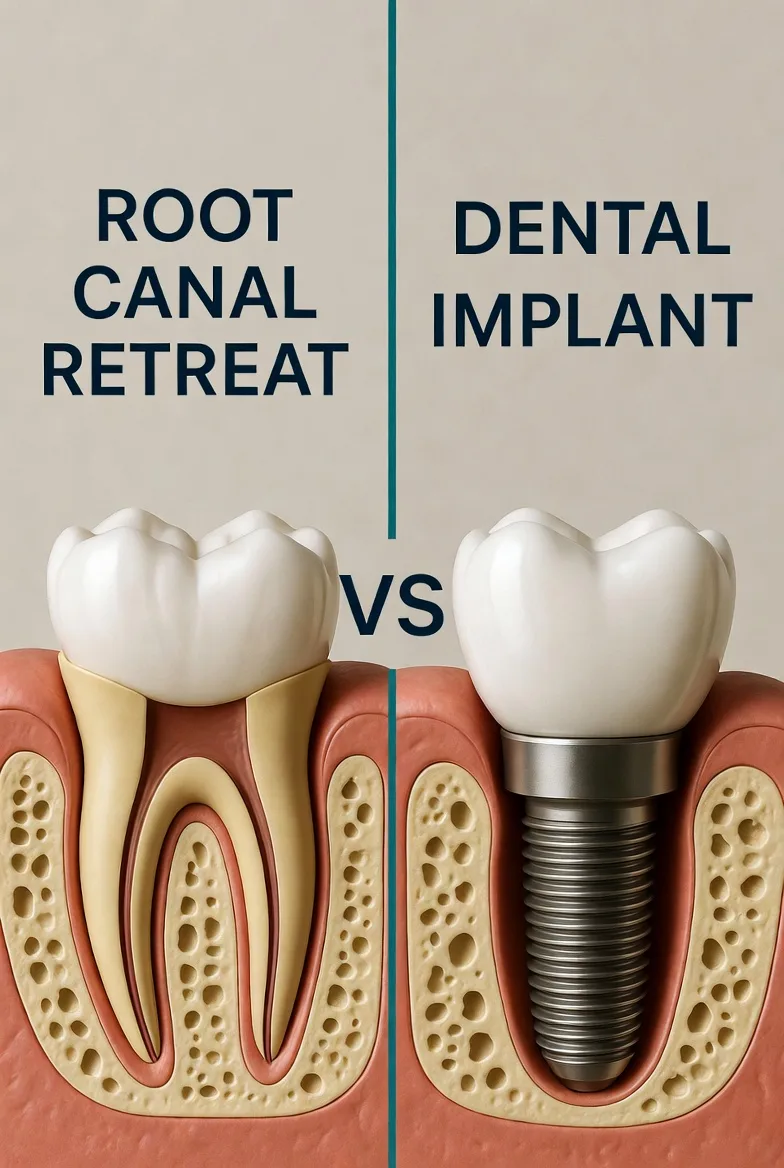
When a root canal fails, the choice feels different than the first time — the tooth already "had its chance." But most failures are specific, findable problems, not verdicts on the tooth. Here's how the retreat-or-replace decision actually gets made.
| FAVORS RETREATMENT | FAVORS IMPLANT |
|---|---|
| A findable cause — missed canal, leakage, contamination through a failed restoration | Vertical root fracture confirmed on CBCT |
| Sound root and restorable structure | Too little tooth left to rebuild even with a post and crown |
| Healthy bone support | Severe bone loss or gum disease |
| 75–85% success in specialist hands | A tooth already retreated twice without healing |
| $1,500–2,500 + restoration | $4,000–6,000+, months of stages |
| Keeps every future option open — apicoectomy (90%+) still available as backup | The one-way door |
The question inside the question.
“Should we retreat?” really asks: why did the first one fail? A missed MB2 (present in up to 90% of upper molars but missed without a microscope) or a leaking crown is a correctable cause — retreatment succeeds at 75–85% precisely because the second pass fixes a specific defect with better tools: CBCT imaging, surgical microscope, and advanced disinfection like GentleWave that can clean areas the first treatment missed. A vertical root fracture is not correctable — no retreatment saves it, and the implant is the honest answer. The CBCT usually tells these apart before anything is spent.
The strongest argument for trying retreatment first is simple: it preserves your options. If retreatment succeeds (75–85% chance), you keep your natural tooth at a fraction of the implant cost. If it doesn’t work, apicoectomy is still available with a 90%+ success rate. If both fail, you can still extract and place an implant — nothing about retreatment compromises future implant placement. Going straight to extraction eliminates all of those intermediate options.
Age changes nothing by itself. Our case files include a 62-year-old’s front tooth, already recommended for extraction, rebuilt with retreatment and a fiber post — indistinguishable from its neighbor a year on, at a fraction of an implant’s cost.
"Retreatment isn't giving the tooth a second chance. It's giving the first treatment's mistake a name."
Findable cause + sound structure: retreat — 75–85% success and every option preserved. Fracture or an unrestorable tooth: implant, planned well, without wasted rounds.
The deciding evidence is one scan away. Never extract a "failed" tooth without it.