Cracked Tooth Treatment Torrance
Here’s something most people don’t realize: cracked teeth are one of the hardest dental problems to diagnose. You can have a crack that causes sharp, shooting pain every time you bite down on something — and your regular dentist might not be able to see it on an X-ray. That’s because traditional 2D X-rays don’t show most cracks. They’re just not built for that.
Dr. Jason Phan sees this all the time at our Torrance office. A patient comes in after weeks (sometimes months) of on-and-off tooth pain. They’ve been to their dentist. Maybe twice. The X-rays look normal. Nothing obvious is wrong. But the pain keeps coming back. And that’s usually when they get referred to us — because finding cracks is literally what endodontists do.
Save Rate (Early Treatment)
Cause of Tooth Loss in US
Microscope Magnification
Why Cracked Teeth Are So Tricky
Let me be honest with you. Cracked teeth are frustrating — for patients and for dentists. The pain doesn’t always make sense. One day it’s awful, the next day it’s gone. You might feel a sharp sting biting into a piece of bread but nothing at all chewing a steak. It’s confusing.
That’s because cracks behave differently depending on how you bite. When you chew, the crack flexes open and shut. The opening motion irritates the nerve inside the tooth. Then when you release, the crack snaps shut, and that’s when the real pain hits. Dentists call this “rebound pain” and it’s one of the biggest clues that a crack is hiding in there.
The other thing that makes cracks tricky? They’re often invisible to the naked eye. A crack can run deep into a tooth and you’d never see it in a mirror. Even dental X-rays miss most of them. That’s where having the right tools — and the right training — makes all the difference.
The 5 Types of Tooth Cracks
Not all cracks are the same. Some are completely harmless. Others are a dental emergency. Here’s a quick breakdown of what Dr. Phan sees most often from patients across Torrance and the South Bay.
Less Serious
-
1.
Craze Lines — Tiny, shallow cracks in the enamel. Almost everyone has them. They look like hairline scratches and cause zero pain. No treatment needed. They're cosmetic, nothing more.
-
2.
Fractured Cusp — A piece of the chewing surface breaks off, usually around a filling. Hurts for a moment, but the nerve is typically fine. A new crown or onlay fixes it.
More Serious
-
3.
Cracked Tooth — A crack that runs from the chewing surface down toward the root. If caught early, a root canal and crown can save it. If it reaches below the gum line, the prognosis gets worse fast.
-
4.
Split Tooth — A cracked tooth that wasn't treated and has now split into two separate pieces. Usually can't be saved. This is what happens when cracks go untreated too long.
-
5.
Vertical Root Fracture — A crack that starts at the root and works its way up. These are sneaky because they often cause minimal symptoms until infection sets in. Often requires extraction.
Dr. Phan's Honest Take
Here's what I tell every patient: the earlier you come in, the more options we have. A crack that could've been saved with a crown on Monday might need a root canal by Friday — or extraction by next month. Cracks don't heal on their own. They only get worse. If something feels off when you bite down, don't wait on it.
How Dr. Phan Finds the Crack
Most general dentists have good eyes and good instincts. But cracked tooth diagnosis really needs specialist-level tools. Here’s what we use at our Torrance office that most dental practices simply don’t have.
CBCT 3D Imaging
Our cone beam CT scanner takes a full 3D picture of your tooth. It shows cracks, infection, and bone loss that flat X-rays completely miss.
Surgical Microscope
At 25x magnification, cracks that are invisible to the naked eye become clearly visible. This is the single most useful tool for crack diagnosis.
Transillumination
A bright light shines through the tooth. Cracks block the light and show up as dark lines. Simple but incredibly effective.
Bite Testing
You bite on a special tool one cusp at a time. If a specific cusp triggers sharp pain on release, that tells us exactly where the crack is hiding.
We combine all four methods together. No single test is 100% reliable on its own, but when you layer them — 3D scan, microscope, light test, and bite test — the picture becomes very clear. That’s the advantage of seeing a specialist.
What Causes Teeth to Crack?
People always want to know: “Why did my tooth crack?” Sometimes there’s an obvious reason. Sometimes there’s not. But here are the most common causes we see from patients in Torrance, Redondo Beach, Manhattan Beach, and across the South Bay.
Common Causes of Cracked Teeth
- Grinding or clenching teeth (bruxism)
- Chewing ice, hard candy, or popcorn kernels
- Large old fillings that weaken tooth structure
- Sudden temperature changes (hot coffee then ice water)
- Trauma or injury to the face/mouth
- Age — teeth naturally weaken over time
The number one cause Dr. Phan sees? Teeth with big, old amalgam fillings. Those silver fillings from the 80s and 90s did their job for a long time. But metal fillings expand and contract with temperature changes, and over the years, that stress builds up. Eventually the tooth gives out. We see this pattern multiple times a week.
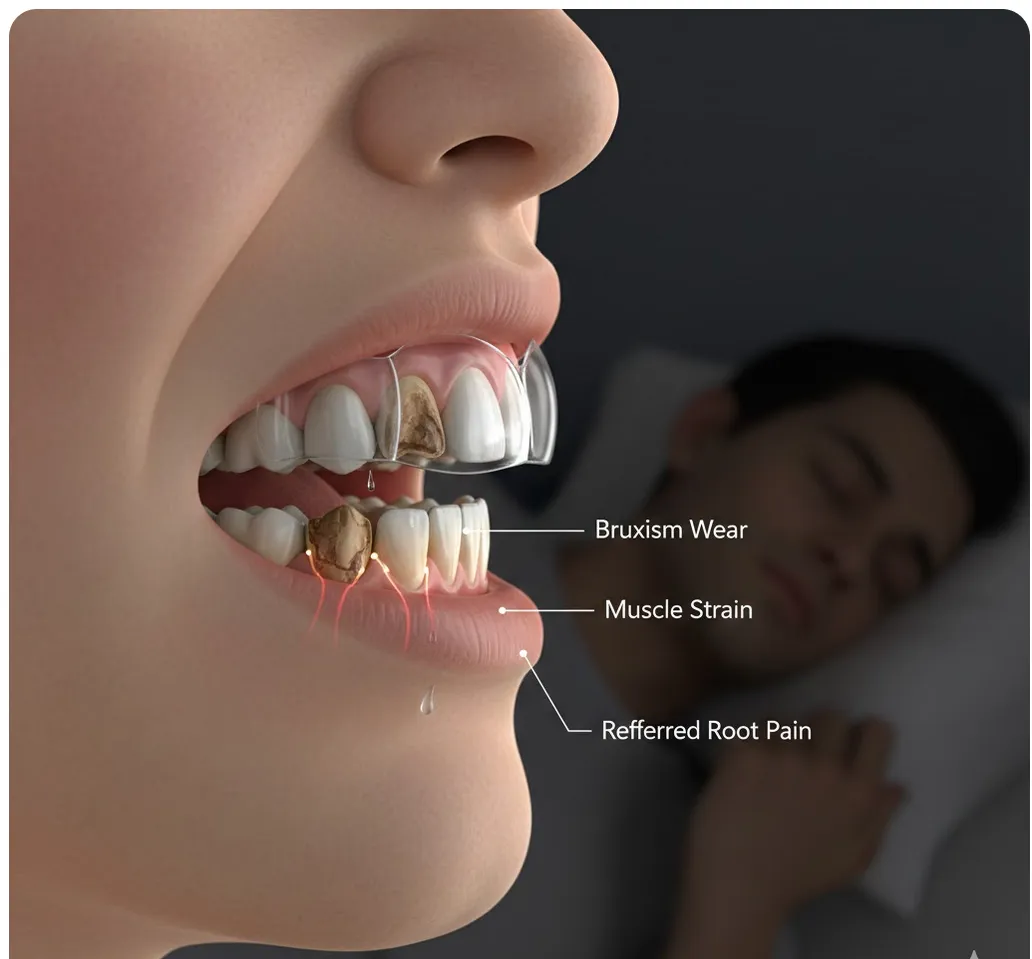
Bruxism is the second biggest one. People who grind their teeth at night — especially during stressful periods — put an enormous amount of force on their back molars. Way more force than chewing ever does. If that’s you, a night guard can save you a lot of pain and money down the road.
Treatment Options
Once Dr. Phan identifies the crack and how far it goes, the treatment plan depends on the severity. We always start with the most conservative option. If bonding can fix it, we won’t jump to a root canal. If a root canal can save the tooth, we won’t pull it. Extraction is always the last resort.
Bonding or Dental Crown (Shallow Cracks)
If the crack only affects the enamel and outer dentin — and the nerve is healthy — a bonded restoration or full crown can hold the tooth together and prevent the crack from spreading. This is the simplest fix. Your dentist handles this one.
Root Canal + Crown (Crack Reaching the Nerve)
When the crack extends into the pulp chamber — where the nerve lives — the nerve gets irritated and infected. A root canal removes the damaged nerve, cleans the inside of the tooth, and seals it. Then your dentist places a crown to hold everything together. This is the most common treatment we perform for cracked teeth.
Biomimetic Bonding (Conservative Approach)
Dr. Phan uses biomimetic techniques when possible. "Biomimetic" just means we're mimicking how the natural tooth works. Instead of removing a lot of tooth structure for a traditional crown, we bond a restoration directly to the tooth in layers. This preserves more of your natural tooth and can actually help hold the crack together. It's not right for every case, but when it works, the results are excellent.
Extraction (Last Resort)
If the crack runs below the gum line and splits the root, or if the tooth has split into two pieces, there's no way to reliably save it. We don't recommend extraction unless we've confirmed the tooth truly can't be saved. Your dentist can then replace the tooth with an implant or bridge.
Why an Endodontist — Not Just a Dentist
You might be wondering: can’t my regular dentist handle a cracked tooth? Sometimes, yes. If the crack is obvious and doesn’t involve the nerve, your dentist can place a crown and that’s that.
But here’s where things get real. Most of the time, the tricky part isn’t the treatment — it’s the diagnosis. Is the nerve involved? How far does the crack go? Is it saveable or not? These are the questions that change everything about your treatment plan. And answering them requires a microscope, 3D imaging, and years of specialized training.
| Feature | General Dentist | Endodontist (Dr. Phan) |
|---|---|---|
| Crack Diagnosis Training | Basic dental school | 2-3 years advanced specialty training |
| Microscope | Rarely available | 25x surgical microscope — used on every case |
| 3D Imaging (CBCT) | Not typically available | In-office cone beam CT scanner |
| Cracked Teeth Per Month | A few | Dozens — it's a big part of what we do |
| Can Perform Root Canal | Sometimes (simple cases) | Yes — specialized expertise for complex cracks |
Dr. Phan works alongside general dentists in Torrance and the South Bay every day. Your dentist handles the crown. We handle the diagnosis and root canal. It’s a team effort, and it gives you the best possible outcome.
Signs You Should Come In Right Away
Some cracks can wait a few days for an appointment. Others need same-day attention. Here’s what to watch for.
Call Us Today If You Have These Symptoms
URGENT- Sharp pain when biting that lingers
- Swelling around the gum near a painful tooth
- A piece of your tooth broke off
- Sensitivity to hot or cold that doesn't go away
- Pain that wakes you up at night
- You can feel a crack line with your tongue
What Happens at Your Appointment
If you’re coming in for a suspected cracked tooth, here’s what to expect. No surprises.
We Listen First
You tell us what's been going on. When did the pain start? What makes it worse? Does cold bother it? Does it hurt to chew? Every detail helps narrow things down.
Testing and Imaging
Bite test, cold test, transillumination, and a CBCT 3D scan if needed. We're gathering data from every angle to pinpoint the exact crack and how deep it goes.
Microscope Exam
Dr. Phan examines the tooth under the surgical microscope at 25x magnification. Sometimes we'll remove an old filling to see the crack more clearly. Staining dye can also make cracks stand out.
We Talk About Your Options
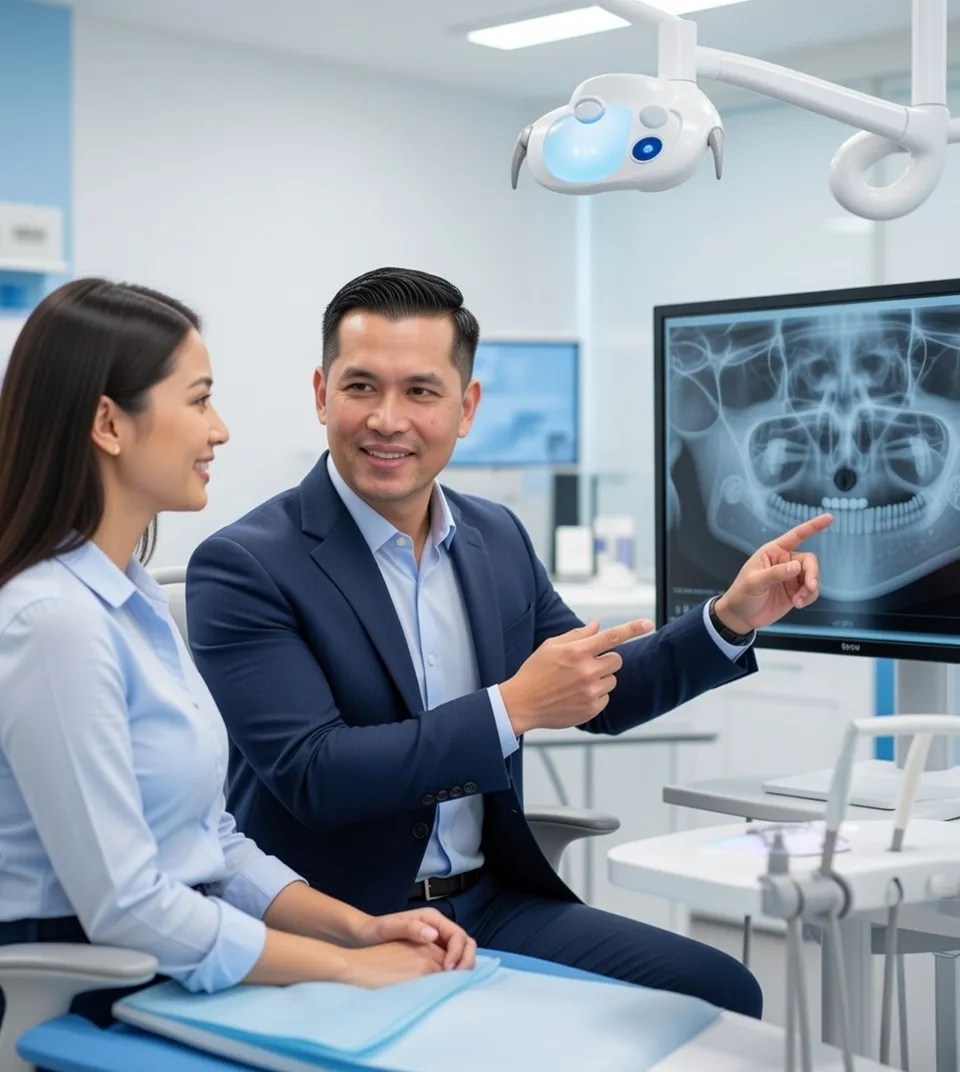
Once we've identified exactly what's going on, Dr. Phan sits down with you and walks through the options. Photos and images included. You'll understand what's happening with your tooth and why we're recommending what we're recommending. No pressure. Just clarity.
Treatment (If Needed Same Day)
If the tooth needs a root canal and you want to get it done right away, we can often treat it during the same visit. One less trip to the office.
A Real-World Example
A patient from Hermosa Beach came in last year after three months of weird, random tooth pain. Her general dentist had done two X-rays and a cold test — everything looked normal. She was starting to wonder if the pain was in her head.
Five minutes with the microscope and transillumination, and we found it. A hairline crack running from under an old filling down into the dentin. Not visible on any X-ray. Not visible to the naked eye. But there it was.
She got a root canal that day and a crown from her dentist the following week. The pain was gone completely. Three months of mystery solved in one visit.
That’s the kind of thing we do every day at our Torrance practice.
Our Conservative Philosophy
Dr. Phan’s approach is simple: save as much natural tooth as possible. A natural tooth, even one that’s been cracked and treated, is still better than an implant in most cases. Your body knows how to work with its own teeth. The ligament around the root acts as a shock absorber. That’s something an implant can never replicate.
Our goal is always to save your tooth. We use the least invasive approach that will give you a long-term result. That means:
- • Biomimetic bonding when a full crown isn't necessary
- • Preserving as much healthy tooth structure as we can during root canal
- • Using biocompatible materials that work with your body
- • Honest assessment — if the tooth truly can't be saved, we'll tell you straight
Cost and Insurance
Cracked tooth treatment costs vary depending on what your tooth actually needs.
| Treatment | Typical Cost | When It's Needed |
|---|---|---|
| Bonding Repair | $300-$500 | Shallow crack, no nerve involvement |
| Crown | $800-$1,500 | Moderate crack, tooth needs protection |
| Root Canal + Crown | $1,300-$2,000 | Crack reaches the nerve/pulp |
| Extraction + Implant | $3,500-$6,000 | Tooth can't be saved (last resort) |
We accept most PPO dental insurance. Our front office team will verify your benefits before treatment so there aren’t any surprises. We also offer CareCredit financing if you need to spread out payments. We’d rather you get the treatment you need now than wait because of cost — waiting almost always makes things worse and more expensive.
Serving Torrance and the South Bay
Our office is in Torrance, right off Hawthorne Blvd. We see patients from all over the South Bay — Redondo Beach, Hermosa Beach, Manhattan Beach, Palos Verdes, Carson, Gardena, Lomita, and Harbor City. Most of our patients are referred by their general dentist, but you’re welcome to call us directly if you think you have a cracked tooth.
We offer same-day and next-day appointments for urgent cases. Emergency appointments are always available because cracked tooth pain doesn’t wait for a convenient time.
Schedule Your Cracked Tooth Evaluation
If you’ve been dealing with mysterious tooth pain — the kind that comes and goes, hurts when you bite, or gets sharp with hot and cold — there’s a good chance a crack is the problem. Don’t ride it out. The sooner we find it, the more options we have to save the tooth.
Call our Torrance office or use the online form to book your appointment. Dr. Phan will take a look, give you an honest answer, and lay out your options. No runaround, no upselling — just straight talk about what’s going on with your tooth and what we can do about it.
Specialist diagnosis. Advanced technology. Honest answers.