
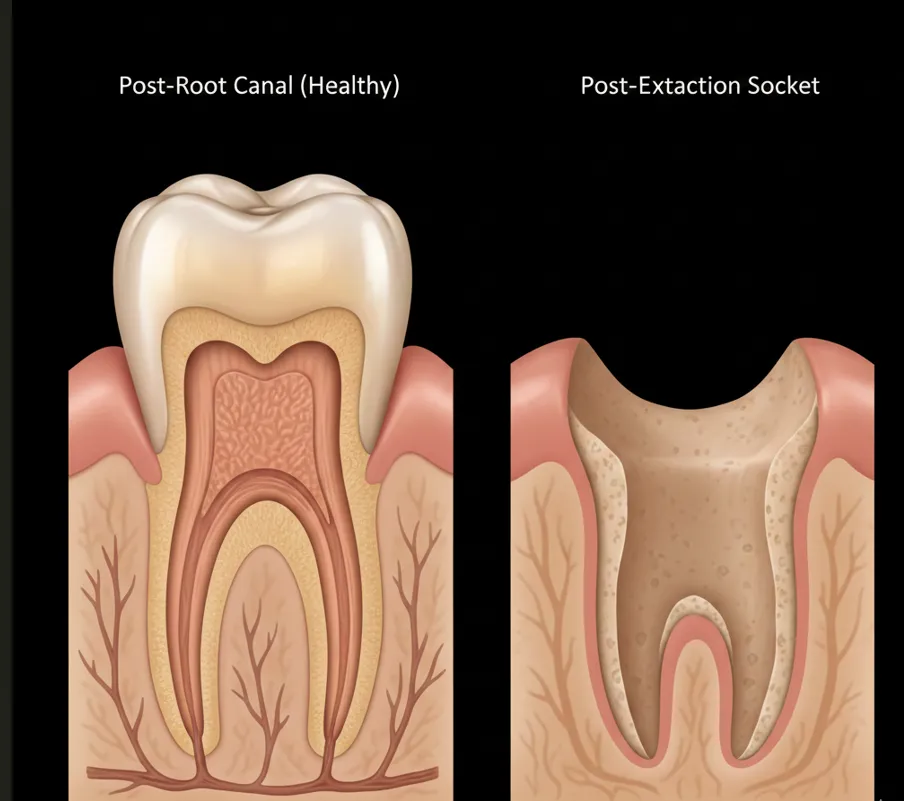
“Should I just have it pulled?”
I hear this question almost daily. A patient is dealing with a painful or infected tooth and is weighing their options: save the tooth with a root canal, or extract it and move on. It’s a reasonable question, and the answer isn’t always the same for every patient.
Here’s an honest comparison to help you make an informed decision.
The Short Answer
If the tooth can be saved, saving it is almost always the better option. Your natural tooth functions better than any replacement, lasts longer, and costs less over your lifetime. But there are situations where extraction is the right call.
Let’s look at the details.
Root Canal vs. Extraction: What You’re Getting
Root Canal Treatment
A root canal removes the infected or damaged tissue inside your tooth while preserving the tooth itself. After treatment, your tooth is restored with a crown and continues to function normally.
Advantages:
- Preserves your natural tooth. Nothing functions like the original. Your natural tooth has a periodontal ligament that absorbs chewing forces and maintains bone density—no replacement can replicate this.
- High success rate. Root canal treatment succeeds 90–97% of the time, depending on the tooth and complexity.
- One-step solution. The root canal and crown complete the treatment. There’s no gap to fill, no surgery to place an implant, no waiting months for healing.
- Lower total cost. Root canal + crown typically costs $2,100–$3,500. Compare that to extraction + implant at $4,000–$6,000+.
- Fast recovery. Most patients return to normal activities the next day.
Considerations:
- The tooth will need a crown (additional cost, done by your general dentist)
- A small percentage of treated teeth may eventually need retreatment
- Severely damaged teeth may not be candidates for root canal
Tooth Extraction
Extraction removes the entire tooth. If you want to replace it (and in most cases, you should), you’ll need an implant, bridge, or removable partial denture.
Advantages:
- Lower upfront cost for the extraction itself ($200–$600)
- Quick procedure (typically 20–45 minutes)
- Definitive in the sense that the problem tooth is gone
Considerations:
- You’ll need a replacement. A missing tooth causes neighboring teeth to shift, the opposing tooth to over-erupt, and the jawbone to deteriorate in that area.
- Implants are expensive and time-consuming. An implant requires surgery to place the post, 3–6 months of healing, then a second procedure for the crown. Total timeline: 4–9 months. Total cost: $4,000–$6,000+.
- Bridges sacrifice healthy teeth. A traditional bridge requires grinding down the two teeth adjacent to the gap.
- Bone loss begins immediately. After extraction, the jawbone in that area starts to shrink. This can affect your facial appearance over time and complicate future implant placement.
Side-by-Side Comparison
| Factor | Root Canal + Crown | Extraction + Implant |
|---|---|---|
| Total cost | $2,100–$3,500 | $4,000–$6,000+ |
| Treatment time | 2–3 appointments over 2–4 weeks | 4–9 months |
| Success rate | 90–97% | 95% (but more complex) |
| Bone preservation | Yes | Requires grafting in many cases |
| Feel and function | Natural | Close to natural, but not identical |
| Longevity | Can last a lifetime | Implant can last a lifetime |
| Adjacent teeth affected | No | No (implant) / Yes (bridge) |
When Is Each Option Right?
When Root Canal Is the Right Choice
Root canal treatment is typically recommended when:
- The tooth has a viable structure. Enough healthy tooth remains to support a crown.
- The infection is treatable. The root canal system can be cleaned and sealed effectively.
- The tooth is important for function. Molars for chewing, front teeth for appearance and speech.
- The patient wants to preserve natural teeth. This is the majority of patients.
Most infected or damaged teeth fall into this category. Even teeth that other dentists have said “need to come out” can sometimes be saved with specialist-level care. Endodontists regularly save teeth that are considered borderline.
When Extraction Makes More Sense
Extraction is sometimes the better option:
- Vertical root fracture. A crack running lengthwise down the root usually can’t be repaired. The tooth will continue to have problems.
- Severe structural damage. If decay or fracture has destroyed too much of the tooth, there isn’t enough structure left to restore.
- Advanced periodontal disease. If the bone supporting the tooth is severely compromised by gum disease, saving the tooth may not be feasible.
- Non-restorable tooth. Some teeth are positioned or damaged in ways that make restoration impractical.
- Failed previous treatment. If a root canal and retreatment have both failed, extraction may be the final option. However, apicoectomy (root-end surgery) is worth considering first.
Important: These determinations require proper diagnosis with adequate imaging. What looks like a hopeless tooth on a 2D X-ray may turn out to be saveable when evaluated with 3D CBCT imaging and a microscope.
The “Just Pull It” Mentality
Some patients lean toward extraction because it seems simpler—one appointment and the pain is gone. I understand the appeal, but it’s worth considering:
Myth: Extraction is the end of treatment — one appointment and you're done.
Reality: Unless the tooth is a wisdom tooth or you're okay with a permanent gap, you'll need replacement. That means more procedures, more healing time, and more cost.
Myth: An implant is just as good as a natural tooth.
Reality: You only get one set of natural teeth. An implant is a good replacement, but it doesn't have the proprioceptive feedback of a natural tooth (the ability to sense pressure and bite force). It requires meticulous hygiene to prevent peri-implantitis. And while implants have excellent longevity, they can fail too.
Saving a tooth now doesn’t prevent extraction later. If a root canal doesn’t work out, you can still extract the tooth and place an implant. But if you extract first, you can never get that natural tooth back.
How We Help You Decide
At our office, the decision process looks like this:
Thorough Examination
Using a surgical microscope to evaluate the tooth structure, cracks, and condition.
CBCT 3D Imaging
Assessing the roots, bone, and any infection in detail that standard X-rays can't show.
Vitality Testing
Determining the current state of the tooth's nerve.
Honest Assessment
We tell you whether the tooth is saveable, what the prognosis is, and what we'd do if it were our own tooth. If extraction is the better option, we'll tell you that directly.
We don’t push treatment. If your tooth genuinely can’t be saved, we’d rather tell you that than attempt a root canal that’s unlikely to succeed.
The Bottom Line
For the majority of patients, saving the tooth with a root canal is the better clinical and financial decision. It preserves your natural anatomy, costs less overall, and avoids the complexity of tooth replacement.
Extraction is appropriate in specific circumstances, but it should be a last resort rather than a first choice—especially without a specialist evaluation to confirm the tooth truly can’t be saved.
Not Sure Which Option Is Right?
If you’ve been told you need a root canal or extraction and want a second opinion, we provide thorough evaluations with honest recommendations. We’ll show you exactly what’s happening with your tooth and walk through your options together.
Call (310) 378-8342 to schedule a consultation at Phan Endodontic Partners.