
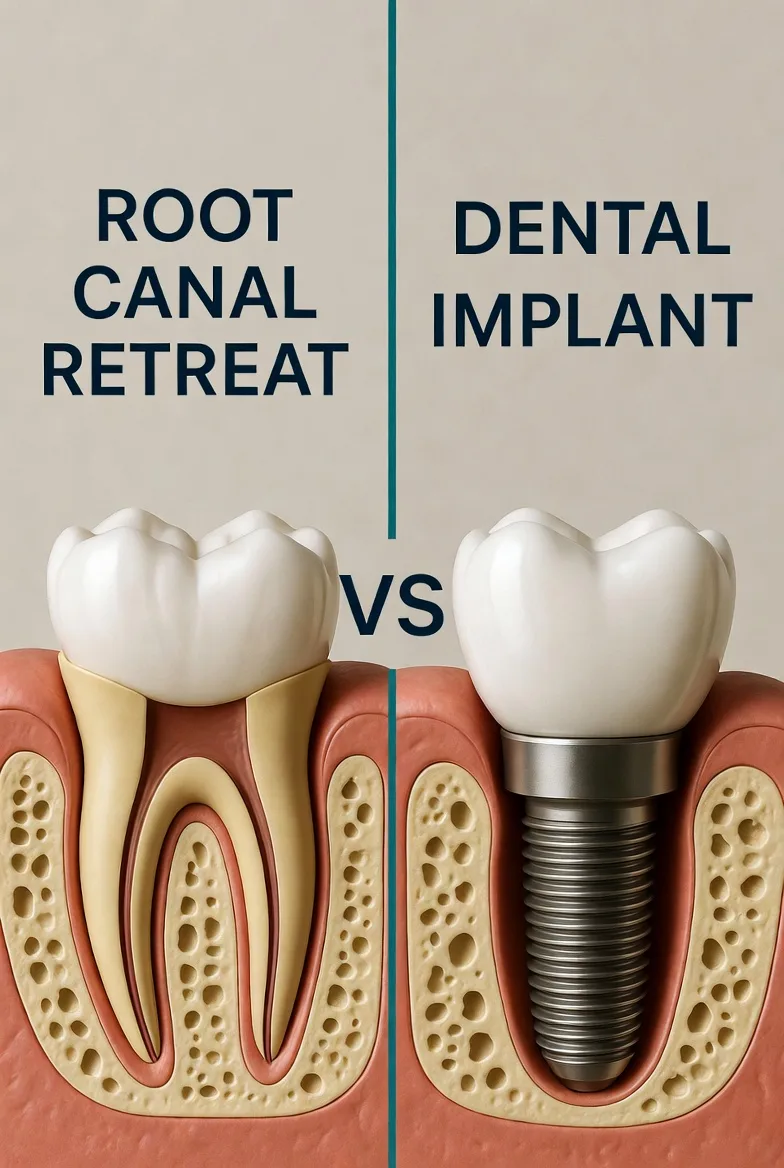
Implants are a genuine marvel — and also a billion-dollar industry with a marketing budget your natural tooth doesn't have. So here is the comparison as an investment ledger: costs, timelines, success rates, and the biology that doesn't show up on invoices.
| ROOT CANAL + CROWN | EXTRACTION + IMPLANT | |
|---|---|---|
| Upfront cost | $2,100–3,500 all-in | $4,000–6,000+ |
| Timeline | Done in 2–4 weeks | 4–9 months, multiple stages |
| Success | 90–97% (specialist) | ~95% (well-placed) |
| Feeling | Natural — the periodontal ligament senses pressure, acts as a shock absorber, and stimulates bone maintenance | No ligament; reduced bite feedback |
| Bone | Stimulated and preserved by the root | Preserved at the implant, resorbs nearby; bone grafting often needed |
| Surgery | Non-surgical, through the top of the tooth | 1–3 surgical procedures (extraction, graft, implant placement) |
| Long-term risks | Possible retreatment (75–85% success), fracture | Peri-implantitis (12–22% incidence), screw/crown issues, crown replacement every 10–15 years |
| If it fails | Apicoectomy (90%+) or implant still fully available | No going back to the natural tooth |
The asymmetry that decides close calls.
Look at the last row. A root canal that eventually fails still leaves the implant option fully open — you’ve lost nothing but time, during which you had your own tooth. An extraction is one-directional: the natural tooth is gone forever. When the odds are close, the reversible choice is the rational one. That asymmetry — not sentiment — is why “save it if it’s saveable” is sound investing.
Your natural tooth has something no implant can replicate: a periodontal ligament. This thin layer of tissue cushions biting forces so they don’t transfer directly to bone, senses bite pressure with remarkable precision (you instinctively know how hard to bite on an almond versus a grape), and signals your jawbone to maintain itself. After extraction, that signal disappears and the bone begins to shrink.
"No implant company has yet built a periodontal ligament."
When the implant is the right answer.
A vertically fractured root, a tooth hollowed past rebuilding, a foundation lost to gum disease — pouring money into a doomed root canal is worse than a well-planned implant, and we say so at consultation. The scan decides; neither ideology should.
- Vertical root fracture confirmed on CBCT — a crack running down the root can't be repaired
- Severe structural damage — too little tooth left to restore even with a post and crown
- Advanced periodontal disease — severe bone loss makes the tooth unsaveable regardless of root canal treatment
- Failed retreatment and surgery — when retreatment, apicoectomy, and all options have been exhausted
And sometimes neither is needed. Conditions like cracked tooth syndrome, sinus infections, myofascial pain, and bruxism can mimic root canal symptoms — a thorough evaluation with 3D imaging can distinguish these, potentially saving you from an unnecessary procedure altogether.
Comparable success rates — but the root canal costs roughly half, finishes in weeks, keeps living biology, and preserves the implant as a future option. The extraction forecloses everything.
Get the tooth's actual prognosis on a scan before choosing. Close call? Keep the original.