
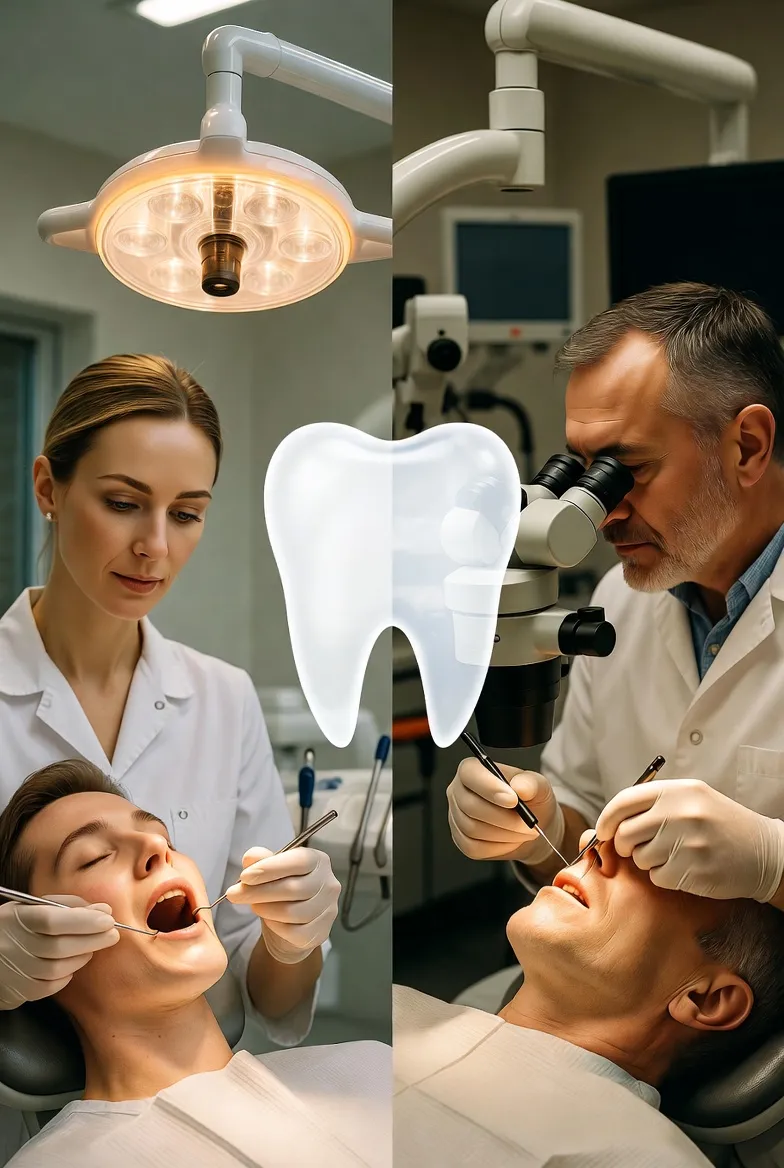
Your general dentist can legally perform your root canal, and many do them well. So why do dentists send us their own families? It comes down to repetition, equipment, and the kind of anatomy that punishes anything less. Here's the honest comparison.
| GENERAL DENTIST | ENDODONTIST | |
|---|---|---|
| Training | Dental school (4 years) | +2–3 years of specialty residency focused exclusively on root canal treatment |
| Volume | ~1–2 root canals a week | 15–25 a week — nothing else |
| Magnification | Loupes (2–4x), or none | Surgical microscope at up to 25x |
| Imaging | Standard 2D X-rays | CBCT 3D imaging in-office |
| Success rates | ~85–90% (published averages) | ~95–97% (published averages) |
| Hard anatomy | Refers out | The daily work — calcified, curved, retreatments |
| Time | Often two 90-minute appointments | Typically one 60–90 minute visit |
Where the 10 points actually live.
The published gap — roughly 95% versus 85% — isn’t about talent; it’s about hidden anatomy. Upper molars conceal a second MB canal in most cases, and finding it without a microscope is genuinely hard. Missed canals are the number-one cause of failure — and the number-one thing repetition plus magnification prevents. Our own tracked outcomes across 1,683 follow-up visits run 96% healed or healing, and we publish the methodology.
A failed root canal isn’t just inconvenient. It means retreatment ($1,500–$2,500 additional) or extraction plus implant ($4,000–$6,000+). The higher upfront success rate often makes the specialist the more economical choice long-term.
When your dentist is the right choice.
A straightforward front tooth or premolar with open, visible anatomy? A skilled GP does fine work at a fair price — and we’ll say so. Molars, retreatments, calcified canals, unclear diagnoses, cracked teeth, or a history of “couldn’t get numb”: that’s specialist territory, and the referral usually costs less than the redo.
An endodontist typically charges 10–20% more than a general dentist for the same procedure. For a molar root canal, the difference might be $200–$400. Most dental insurance plans cover endodontist fees at the same rate as general dentist fees, so the out-of-pocket difference is often minimal.
Many general dentists know their limits and will refer complex cases to an endodontist. If your dentist recommends a referral, that’s a good sign — it means they’re prioritizing your outcome over keeping the procedure in-house.
For simple anatomy, a good general dentist is a fine choice. For molars, retreatments, and anything ambiguous, specialist volume and equipment measurably change the odds.
The cheapest root canal is the one done right the first time — whoever does it.