
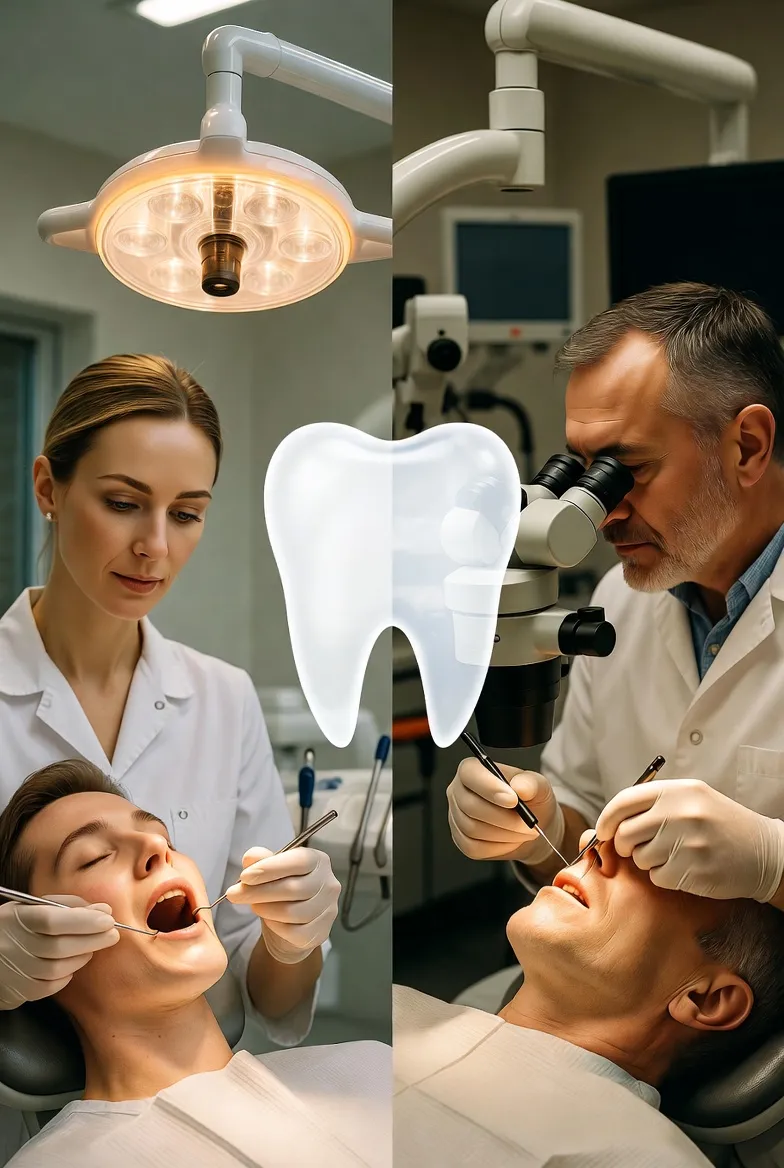
Your dentist just told you that you need a root canal. Now you’re wondering: should you have it done right here, or should you see a specialist? It’s a fair question, and the answer depends on your specific situation.
Here’s an honest comparison of what endodontists and general dentists each bring to the table.
What Is an Endodontist?
An endodontist is a dentist who completed 2–3 additional years of residency training focused exclusively on diagnosing tooth pain and performing root canal treatment. Think of it like the difference between a family doctor and a cardiologist—both are physicians, but one has specialized training in a specific area.
To become an endodontist:
- Complete a 4-year dental school program (DDS or DMD)
- Complete a 2–3 year endodontic residency at an accredited program
- Pass specialty board examinations
During residency, endodontists perform hundreds of root canal procedures under expert supervision, including the most complex cases that general dentists typically refer out.
Key Differences
Training and experience
| General Dentist | Endodontist | |
|---|---|---|
| Dental school | 4 years | 4 years |
| Specialty residency | None | 2–3 years (endodontics only) |
| Root canals per week | 1–2 on average | 15–25 |
| Scope of practice | All dental procedures | Root canals and related procedures exclusively |
A general dentist divides their time across cleanings, fillings, crowns, extractions, cosmetic work, and more. An endodontist spends virtually every working hour doing root canals. That volume of focused experience matters, especially for difficult cases.
Equipment
This is one of the most significant practical differences:
Endodontist Equipment
- Surgical operating microscope — up to 25x magnification for every procedure. Root canals are tiny — some are thinner than a human hair.
- CBCT 3D imaging — cone-beam CT scanners produce 3D images revealing hidden canals, cracks, and infections that standard X-rays miss.
- Ultrasonic instruments — specialized tools for locating and cleaning canals with precision, especially in retreatment cases.
General Dentist Equipment
- Loupes (magnifying glasses) — typically 2–4x magnification, or no magnification at all.
- Standard 2D X-rays — limited view of tooth anatomy and surrounding structures.
- Standard instruments — effective for routine cases but may be insufficient for complex anatomy.
Success rates
Research consistently shows higher success rates for endodontist-performed root canals:
- Endodontist success rate: 95–97%
- General dentist success rate: 85–90%
The difference is more pronounced in complex cases—molars with unusual anatomy, calcified canals, retreatments, and teeth with previous complications.
A failed root canal isn’t just inconvenient. It means retreatment (additional cost and time) or extraction (losing the tooth entirely). The higher upfront success rate often makes the specialist the more economical choice long-term.
Time
Endodontists are generally faster. Because root canals are all we do, we’ve refined our techniques and workflow. A molar root canal that might take a general dentist two 90-minute appointments can often be completed by an endodontist in a single 60–90 minute visit.
When You Should Definitely See an Endodontist
Molar root canals
Molars have 3–4 canals (sometimes 5+) with complex anatomy. The risk of missed canals is significantly higher without microscope magnification.
Retreatments
If a previous root canal has failed, retreatment requires removing old filling material from the canals—a technically demanding procedure.
Calcified canals
Older patients or teeth with a history of trauma often have canals that have narrowed or calcified, making them extremely difficult to locate and treat.
Cracked teeth
Diagnosing a cracked tooth requires careful evaluation, often with a microscope and 3D imaging. The crack’s extent determines whether the tooth can be saved.
Unusual anatomy & surgical cases
Some teeth have extra canals, curved roots, or other variations that require specialized skills. If non-surgical treatment isn’t possible, an apicoectomy (root-end surgery) requires microsurgical skills and equipment.
When a General Dentist May Be Fine
For straightforward cases, a skilled general dentist can deliver good results:
- Front teeth with a single, straight canal
- Premolars with straightforward anatomy
- Teeth with clear, uncomplicated diagnoses
- Your dentist has significant root canal experience and uses magnification
Many general dentists know their limits and will refer complex cases to an endodontist. If your dentist recommends a referral, that’s a good sign—it means they’re prioritizing your outcome over keeping the procedure in-house.
What About Cost?
An endodontist typically charges 10–20% more than a general dentist for the same procedure. For a molar root canal, the difference might be $200–$400.
However, consider the full picture:
- A failed root canal that needs retreatment costs $1,500–$2,500
- An extraction plus implant costs $4,000–$6,000+
- The time and discomfort of additional procedures
For many patients, paying slightly more for a higher success rate is the better financial decision.
Most dental insurance plans cover endodontist fees at the same rate as general dentist fees, so the out-of-pocket difference is often minimal.
Questions to Ask Your Dentist
If your general dentist recommends doing the root canal themselves, ask:
- How many root canals do you perform per month?
- Do you use a microscope for root canals?
- Do you have CBCT 3D imaging?
- What’s your approach if you encounter a complication during treatment?
- Would you refer this case to a specialist?
A confident, experienced dentist will answer these questions directly. If they recommend seeing a specialist, trust that judgment.
The Bottom Line
Both general dentists and endodontists can perform root canals. The question is whether your specific tooth and situation call for the additional training, equipment, and experience a specialist provides.
For simple, straightforward cases, a skilled general dentist may be perfectly appropriate. For anything complex—molars, retreatments, calcified canals, diagnostic puzzles—an endodontist gives you the best chance of saving your tooth the first time.
Need a Specialist Opinion?
If you’ve been told you need a root canal and want a specialist evaluation, we’re here to help. At Phan Endodontic Partners, every case is treated using a surgical microscope and CBCT 3D imaging. We’ll give you an honest assessment of your tooth and all available options.
Call (310) 378-8342 to schedule your consultation.