
“Should I just get an implant instead?”
This is one of the most common questions I hear at our Torrance office. A patient has a damaged or infected tooth, and they’ve heard that implants are the gold standard for tooth replacement. So they’re wondering: why bother saving this tooth when I could just replace it?
It’s a fair question. And the answer might surprise you.
The Short Answer
If your tooth can be saved, a root canal is almost always the better choice. It costs less, takes less time, preserves your natural anatomy, and has an excellent success rate. Implants are a good replacement — but they’re still a replacement. Nothing functions exactly like the tooth you were born with.
Let me break down the details so you can make an informed decision.
Root Canal vs. Implant: What You’re Actually Comparing
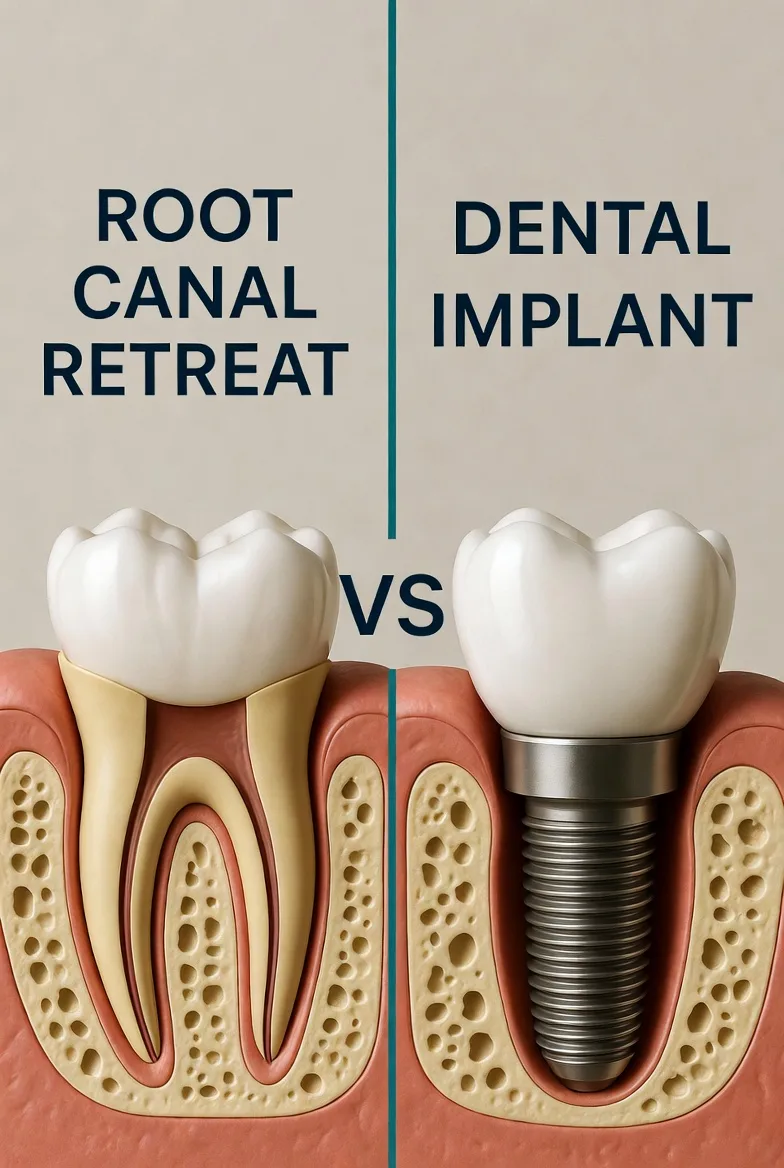
Here’s what’s important to understand: a root canal and an implant aren’t really competing procedures. They’re solutions for different situations. A root canal saves your existing tooth. An implant replaces a tooth that’s already been removed.
The real question is: should you save it or replace it?
Root Canal + Crown
A root canal removes the infected tissue inside your tooth while keeping the tooth itself. Your dentist then places a crown over it. The tooth stays in your jaw, connected by its original periodontal ligament, and continues to function naturally.
Advantages:
- Keeps your natural tooth. Your natural tooth has a periodontal ligament — a thin layer of tissue that acts as a shock absorber, senses bite pressure, and stimulates bone maintenance. No implant can replicate this.
- Lower total cost. Root canal + crown runs $2,100–$3,500. That’s roughly half the cost of an implant.
- Faster completion. Treatment finishes in 2–4 weeks (root canal + crown placement). You’re chewing normally almost immediately.
- High success rate. 90–97% when performed by an endodontist.
- No surgery required. Root canal treatment is a non-surgical procedure done through the top of the tooth.
Considerations:
- The tooth needs a crown (placed by your general dentist)
- A small percentage may eventually need retreatment (75–85% success on a second attempt)
- Severely fractured teeth may not be candidates
Extraction + Dental Implant
Extraction removes the entire tooth. An implant replaces it with a titanium post surgically placed into your jawbone, topped with a custom crown after the bone heals around it.
Advantages:
- High long-term success rate — 95% at 10 years for the implant itself
- Doesn’t rely on the original tooth — good option when the tooth truly can’t be saved
- Can last decades with proper care
Considerations:
- Significantly more expensive. Extraction + bone graft + implant + abutment + crown totals $4,000–$6,000+. Some complex cases exceed $8,000.
- Long treatment timeline. 4–9 months from extraction to final crown. Bone grafting, healing, implant placement, more healing, then crown placement.
- Requires surgery. Implant placement is an oral surgery procedure with its own recovery period.
- Bone graft often needed. After extraction, the jawbone resorbs quickly. Many patients need bone grafting before an implant can be placed, adding cost and time.
- Not immune to failure. Implants can develop peri-implantitis — an infection of the tissue surrounding the implant that can lead to implant loss. About 12–22% of implants develop this condition over time.
Side-by-Side Comparison
| Factor | Root Canal + Crown | Extraction + Implant |
|---|---|---|
| Total cost | $2,100–$3,500 | $4,000–$6,000+ |
| Treatment timeline | 2–4 weeks | 4–9 months |
| Number of procedures | 2 (root canal + crown) | 3–5 (extraction, graft, implant, abutment, crown) |
| Success rate | 90–97% (endodontist) | 95% at 10 years |
| Bone preservation | Natural — maintained by the tooth | Requires grafting in many cases |
| Bite sensation | Natural proprioception | Reduced — no periodontal ligament |
| Recovery time | 1–2 days | Weeks to months |
| Adjacent teeth affected | No | No |
| Reversibility | Can still extract later if needed | Permanent — can’t undo extraction |
What Makes Your Natural Tooth Irreplaceable
This is the part most patients don’t hear about. Your natural tooth has something no implant can replicate: a periodontal ligament.
This thin layer of tissue between your tooth root and the jawbone does three important things:
- Shock absorption. It cushions biting forces so they don’t transfer directly to bone. Implants transmit force straight to bone — which is why implant-supported crowns occasionally fracture or loosen.
- Proprioception. Your natural teeth can sense bite pressure with remarkable precision. You instinctively know how hard to bite on an almond versus a grape. Implants don’t have this feedback, which is why implant patients sometimes bite harder than intended.
- Bone stimulation. The periodontal ligament signals your jawbone to maintain itself. After extraction, that signal disappears and the bone begins to shrink — which is why bone grafting is so often needed.
Think of it this way: An implant is the best artificial replacement available — and it’s genuinely good. But it’s still artificial. Given the choice between keeping what nature gave you and replacing it with titanium and porcelain, your natural tooth wins every time.
When Is Each Option Right?
When root canal is the clear winner
Root canal treatment is the better choice when:
- The tooth has adequate structure to support a crown
- The infection is treatable — the root canal system can be cleaned and sealed
- No vertical root fracture — the root itself is intact
- Sufficient bone support exists around the tooth
- You want to preserve your natural tooth (which is most patients)
This describes the vast majority of cases I see. Even teeth that have been called “hopeless” by other providers can often be saved with specialist-level care, microscope diagnosis, and CBCT 3D imaging.
When an implant is the better option
An implant becomes the right choice when:
- Vertical root fracture. A crack running down the length of the root can’t be repaired. The tooth will continue to have problems.
- Severe structural damage. If decay or fracture has destroyed too much tooth, there isn’t enough structure left to restore — even with a post and crown.
- Advanced periodontal disease. Severe bone loss from gum disease can make the tooth unsaveable regardless of root canal treatment.
- Failed retreatment and surgery. If a root canal, retreatment, and apicoectomy have all been attempted, extraction and implant placement may be the final option.
When you might not need either
Sometimes a tooth that “needs a root canal” actually doesn’t. Conditions like cracked tooth syndrome, sinus infections, myofascial pain, and bruxism can mimic root canal symptoms. A thorough evaluation with 3D imaging can distinguish these — potentially saving you from an unnecessary procedure altogether.
This is why a specialist consultation matters. We don’t just treat — we diagnose first.
The “Implants Last Forever” Myth
Myth: Implants last a lifetime, so they're the better long-term investment.
Reality: Implants can last decades, but they're not maintenance-free. Peri-implantitis (infection around the implant) affects 12–22% of implant patients and can lead to implant failure. The implant crown typically needs replacement every 10–15 years. Meanwhile, a well-done root canal with a quality crown can also last a lifetime — at less than half the cost.
Myth: If the root canal fails, I've wasted my money — I'll need the implant anyway.
Reality: A failed root canal doesn't mean the money was wasted. Most failed root canals can be retreated (75–85% success) or saved with apicoectomy (90%+ success). Even if the tooth eventually needs extraction, trying to save it first doesn't compromise implant placement later. But if you extract first, you can never get that natural tooth back.
How We Help You Decide
At our Torrance office, here’s how we approach this decision:
CBCT 3D Imaging
We take a 3D scan to see the complete picture — root anatomy, fractures, infection extent, and bone condition. This tells us far more than a standard X-ray.
Microscope Evaluation
Under 20x magnification, we can identify cracks, hidden canals, and structural details that determine whether the tooth can be saved.
Honest Assessment
We tell you exactly what we find. If the tooth can be saved, we explain the prognosis and what treatment involves. If it can't, we tell you that directly — we don't push treatment on teeth that won't respond.
The Bottom Line
For the vast majority of patients, saving the tooth with a root canal is the better clinical and financial decision. It costs less, finishes faster, preserves your natural anatomy, and keeps your options open for the future.
Implants are an excellent replacement when a tooth truly can’t be saved. But they should be a last resort, not a first choice — especially without a specialist evaluation confirming the tooth is beyond saving.
Considering Your Options?
If you’ve been told you need a root canal — or told the tooth should be extracted for an implant — a specialist evaluation can give you clarity. We’ll show you exactly what’s happening with your tooth on our 3D imaging and microscope, and give you a straight answer about which option makes the most sense for your situation.
Call (310) 378-8342 to schedule a consultation at Phan Endodontic Partners in Torrance.