
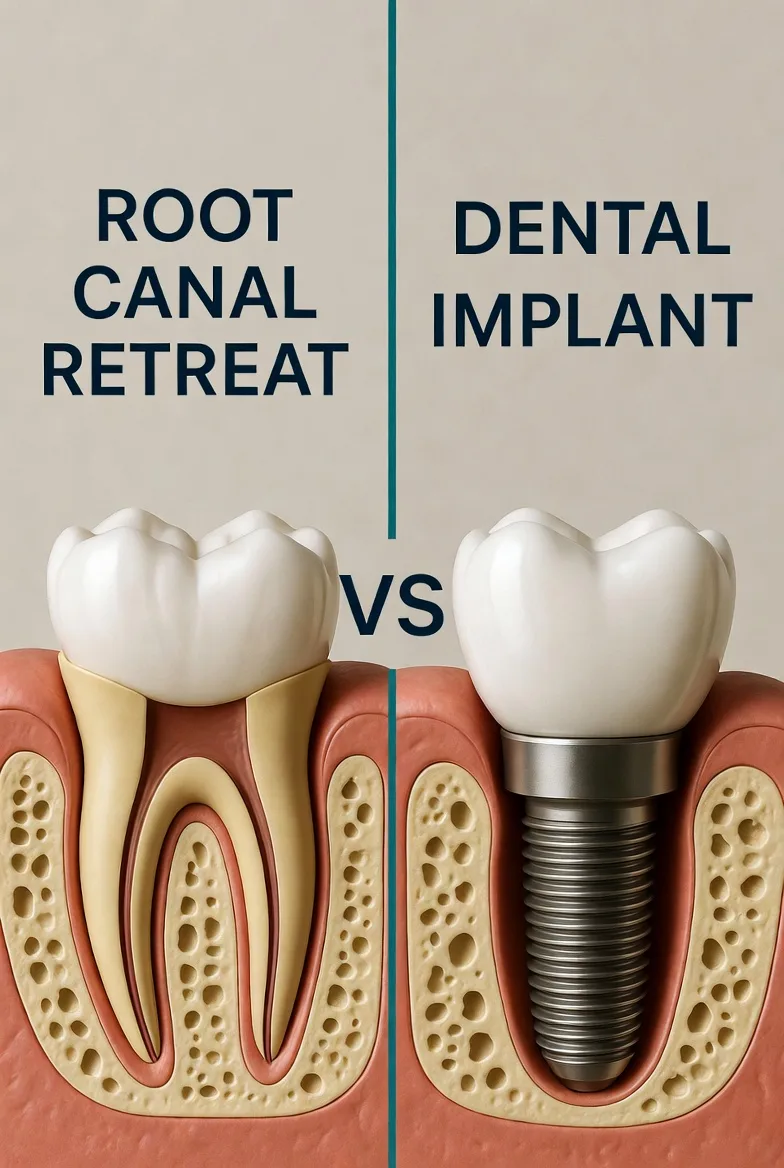
Your first root canal didn’t work. Maybe the pain came back. Maybe there’s a new infection on the X-ray. Maybe your dentist said the tooth “has to come out this time.”
Now you’re facing a decision you didn’t expect: try to save it again with retreatment, or give up on the tooth and go with an implant?
I see patients in exactly this situation every week at our Torrance office. And I’ll tell you what I tell them: the right answer depends on your specific tooth, not a blanket rule. But in most cases, retreatment deserves serious consideration before you give up on a tooth.
Here’s what you need to know to make an informed decision.
Why Your First Root Canal Failed
Before deciding what to do next, it helps to understand why the treatment failed. The reason matters — because some causes are fixable and others aren’t.
Missed canals (most common — and fixable)
The number one cause of root canal failure. Upper molars have a canal called the MB2 that’s present in up to 90% of cases but gets missed without a microscope. If a canal is missed, bacteria stay inside the tooth and the infection returns. This is almost always correctable with retreatment by a specialist using a microscope.
Incomplete cleaning or sealing (fixable)
Root canals have complex anatomy — branches, curves, and lateral canals that can harbor bacteria. If the original treatment didn’t clean these areas thoroughly, infection persists. Modern technology like GentleWave cleaning can reach areas that conventional instruments miss, giving retreatment a strong chance.
New decay or leaky restoration (fixable)
Sometimes the root canal itself was fine, but bacteria re-entered through a failed crown margin or delayed restoration. This is a contamination problem, not a root canal problem — and it’s typically correctable with retreatment plus a new restoration.
Vertical root fracture (not fixable)
A crack running lengthwise down the root can’t be repaired. This is the one situation where retreatment genuinely won’t help, and extraction becomes the right answer. The good news: this can be diagnosed definitively with CBCT 3D imaging and microscope examination before committing to either path.
Key insight: If the failure was caused by a missed canal, incomplete cleaning, or recontamination — which covers the majority of cases — retreatment has a strong chance of working. The original problem gets corrected with better tools and techniques.
Retreatment vs. Implant: The Honest Comparison
Retreatment (Save the Tooth)
Retreatment removes the old root canal filling material, locates and treats missed canals, re-cleans the entire canal system, and re-seals the tooth. It’s more complex than the original root canal but preserves your natural tooth.
What it offers:
- Keeps your natural tooth with its periodontal ligament, bone stimulation, and natural bite sensation
- 75–85% success rate — lower than a first root canal, but still strong odds
- $1,500–$2,500 total cost (retreatment + new crown)
- Completes in 2–4 weeks (retreatment appointment + crown placement)
- If it fails, you can still get an implant. Retreatment doesn’t burn any bridges.
Extraction + Implant (Replace the Tooth)
The tooth is extracted and replaced with a titanium implant post, followed by a custom crown after bone healing.
What it offers:
- 95% success rate at 10 years for the implant itself
- Doesn’t depend on the original tooth — starts fresh
- Can last decades with proper maintenance
What it costs:
- $4,000–$6,000+ total (extraction + bone graft + implant + crown)
- 4–9 months from extraction to final crown
- Multiple surgical procedures — extraction, possible bone graft, implant placement, crown placement
- Irreversible — once the tooth is extracted, there’s no going back
Side-by-Side Comparison
| Factor | Retreatment | Extraction + Implant |
|---|---|---|
| Cost | $1,500–$2,500 | $4,000–$6,000+ |
| Timeline | 2–4 weeks | 4–9 months |
| Success rate | 75–85% | 95% at 10 years |
| Preserves natural tooth | Yes | No |
| Surgery required | No | Yes (1–3 procedures) |
| Bone grafting needed | No | Often yes |
| Bite sensation | Natural | Reduced (no periodontal ligament) |
| If this fails | Apicoectomy or extraction still available | Implant removal, possible re-grafting |
| Recovery | 1–2 days | Weeks to months |
The Decision Framework
Here’s how I think about this decision for each patient I see.
Try retreatment first when:
- The cause of failure is identifiable and correctable — missed canal, incomplete cleaning, contamination through a failed restoration
- The root is intact — no vertical fracture visible on CBCT
- The tooth has adequate structure for a new crown
- There’s reasonable bone support around the tooth
- The patient values keeping their natural tooth
This describes most failed root canal cases. Even when the original treatment was done years ago, retreatment with modern technology — microscope, CBCT, GentleWave — achieves outcomes that were impossible a decade ago.
Go directly to extraction + implant when:
- Vertical root fracture confirmed on CBCT or under the microscope
- The tooth is too broken down to restore even with a post and crown
- Severe bone loss from long-standing untreated infection has eroded most of the support
- Retreatment and apicoectomy have already been tried and the tooth is still failing
- The patient fully understands both options and prefers the implant route
Be cautious about this advice: “Just pull it and get an implant” is sometimes said too quickly. Some providers recommend extraction before a specialist has evaluated whether the tooth can be saved. If you haven’t seen an endodontist, it’s worth getting that assessment before making an irreversible decision.
Why Retreatment Deserves the First Shot
The strongest argument for trying retreatment first is simple: it preserves your options.
- If retreatment succeeds (75–85% chance), you keep your natural tooth at a fraction of the implant cost.
- If retreatment doesn’t work, apicoectomy (root-end microsurgery) is still available as a next step, with a 90%+ success rate.
- If both retreatment and apicoectomy fail, you can still extract and place an implant. Nothing about retreatment compromises future implant placement.
Going straight to extraction eliminates all of those intermediate options. Once the tooth is out, it’s out.
The math: If retreatment costs $2,000 and succeeds 80% of the time, that’s an expected cost of $2,500 to save the tooth (accounting for the 20% who might eventually need an implant anyway). Going straight to implant costs $5,000+. For most patients, the try-to-save-it-first approach is both clinically sound and financially smart.
What Modern Retreatment Looks Like
Retreatment today isn’t what it was 10 or 20 years ago. The technology has fundamentally changed what’s possible.
CBCT 3D imaging shows us exactly why the first treatment failed before we even start — missed canals, separated instruments, extent of infection, root fractures. No guessing.
Surgical microscope at 20x magnification lets us see and treat anatomy that was invisible during the original procedure. That hidden MB2 canal? It shows up almost every time under the scope.
GentleWave cleaning technology uses acoustic energy and fluid dynamics to disinfect areas that conventional files and irrigation can’t reach — lateral canals, isthmus connections, the entire three-dimensional canal system. This is particularly valuable in retreatment, where thorough disinfection is the whole point.
Ultrasonic instruments precisely remove old filling material, posts, and calcifications without sacrificing healthy tooth structure.
These tools don’t just make retreatment possible — they make it predictable.
What About Apicoectomy?
If retreatment doesn’t fully resolve the problem, apicoectomy (root-end microsurgery) is the next step before extraction. This procedure removes just the tip of the root and the surrounding infection through a small incision, without disturbing the rest of the tooth or the crown.
Apicoectomy success rates are 90% or higher when performed microsurgically. It’s a powerful backup option that many patients don’t know exists.
The three-step sequence — retreatment, then apicoectomy if needed, then extraction only as a last resort — gives your natural tooth every possible chance before moving to an implant.
The Bottom Line
A failed root canal is frustrating, but it usually doesn’t mean the tooth is lost. Retreatment corrects the original problem with better technology and a specialist’s expertise. It costs significantly less than an implant, takes weeks instead of months, and — most importantly — keeps your natural tooth.
If retreatment doesn’t work, you still have apicoectomy and then implant as backup options. But extraction is a one-way door. Once the tooth is gone, you can’t change your mind.
Dealing With a Failed Root Canal?
If your root canal didn’t work and you’re deciding what to do next, a specialist evaluation gives you the clearest picture. We’ll take a 3D scan, examine the tooth under the microscope, identify exactly why the first treatment failed, and give you an honest assessment of whether retreatment can save it.
Call (310) 378-8342 to schedule a consultation at Phan Endodontic Partners in Torrance. We see patients from across the South Bay — Redondo Beach, Hermosa Beach, Manhattan Beach, Palos Verdes, Carson, Gardena, and beyond.